
From Immersive Telepresence to Shakespeare Remote
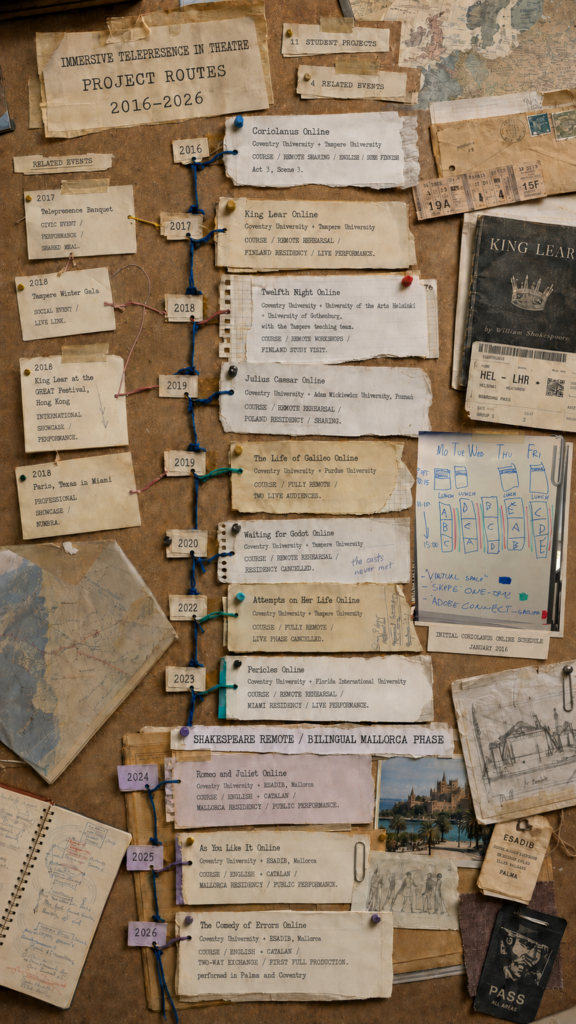
Shakespeare Remote is the current chapter of Immersive Telepresence in Theatre, an international performer-training initiative founded by Coventry University in the UK and Tampere University in Finland. Since its first student collaboration in 2016, it has connected 247 students across eleven projects in six countries.
The name Shakespeare Remote emerged in 2024 as the project entered a new phase with L’Escola Superior d’Art Dramàtic de les Illes Balears (ESADIB) in Mallorca. It did not erase Immersive Telepresence in Theatre, but marked a return to the interest in language that had inspired the original collaboration.
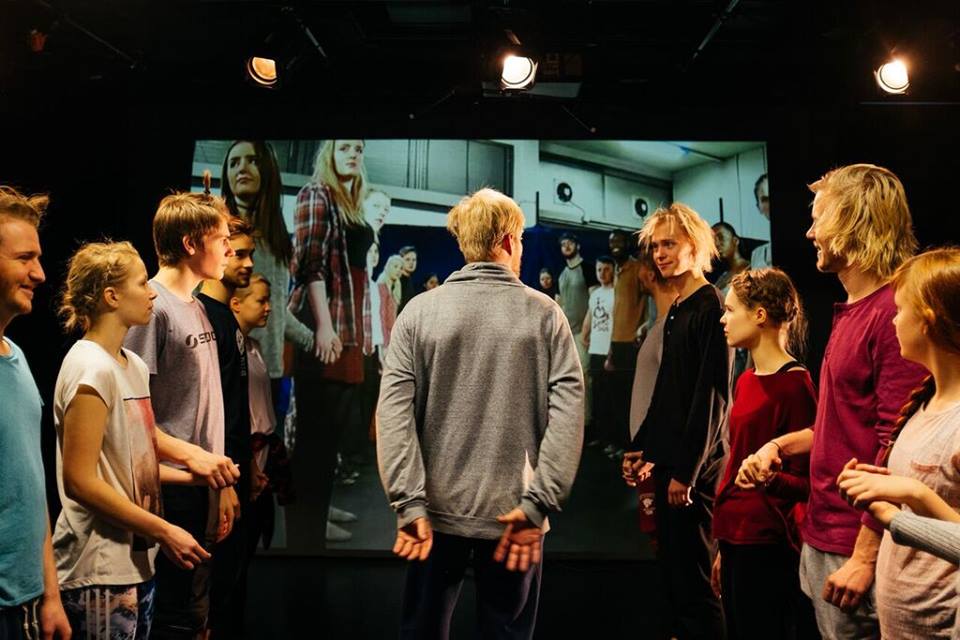
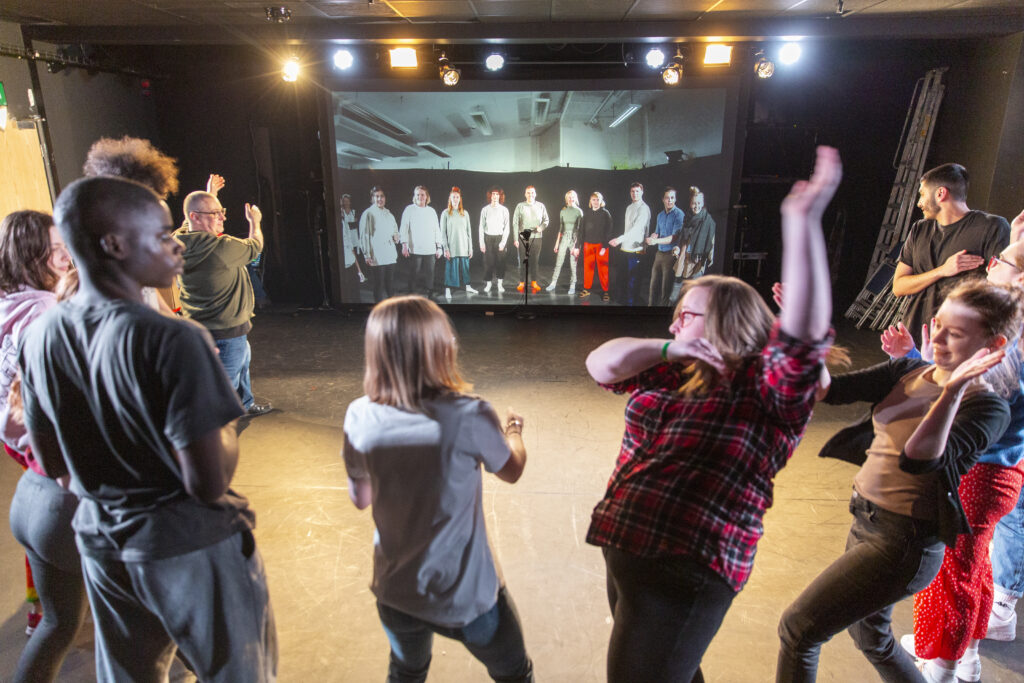
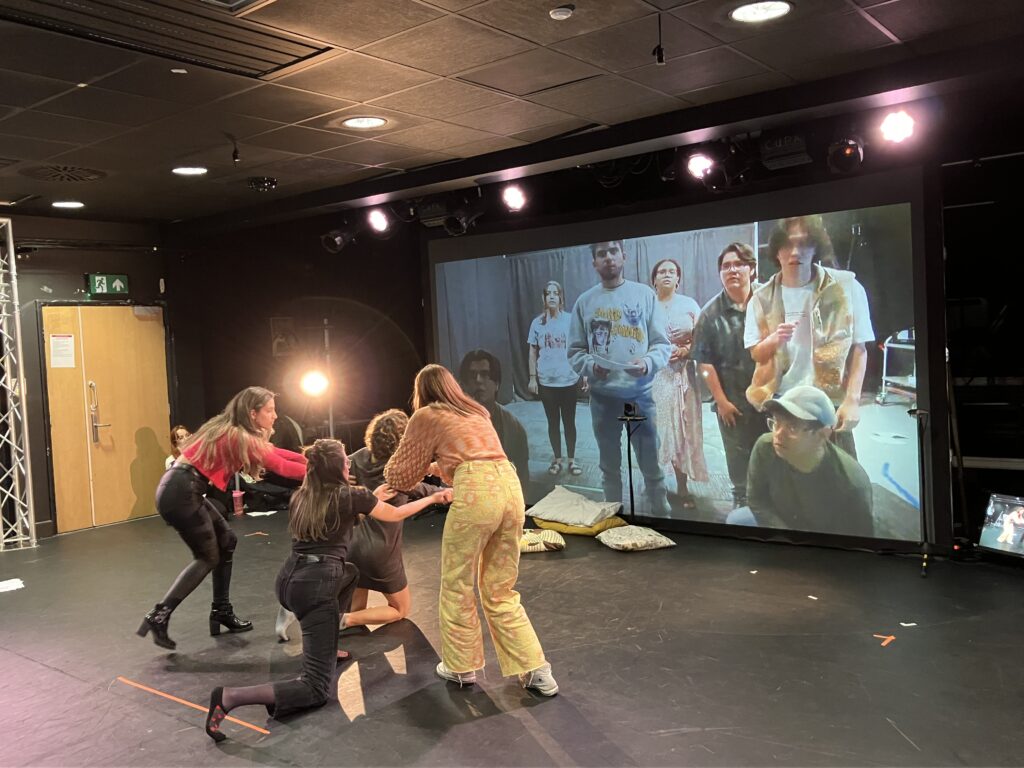
Today, Shakespeare Remote brings acting students from partner institutions together as one international cast. They spend two weeks rehearsing through immersive telepresence, using life-size projection and directional sound, before meeting for a one-week residency. There, they continue rehearsing in person, encounter the host culture and present the completed work to public audiences.
Finnish Origins: Acting in a Foreign Language
The project began with a Finnish approach to performer training. In 2015, Dr Tiina Syrjä of Tampere University’s acting programme, then known as NÄTY, spoke at the International Platform for Performer Training about “acting in a foreign language”, a method pioneered there during the late 1990s under Professor Yrjö J. Renvall and director Hanno Eskola.
Students were asked to perform in a language they did not already understand. Without immediate access to the literal meaning of the words, actors experienced the text as sound, rhythm and physical action. They became more attentive to tone, gesture, breath, memory and their scene partners. Language created difficulty, but that difficulty became the source of the learning.
In June 2015, Tom Gorman travelled to Tampere to meet Tiina and her colleague Dr Mikko Kanninen. Their different approaches to performer training suggested a practical collaboration using Shakespeare, and they selected Act III, Scene III of Coriolanus for students in Coventry and Tampere to rehearse together.
What we did not yet have was a workable method, a dedicated budget or suitable equipment. Initial plans involved Skype or Adobe Connect on individual laptops, but small screens and ordinary webcams could not convey full-body performance, shared space or meaningful eye contact.
Building the first Shared Rehearsal Room
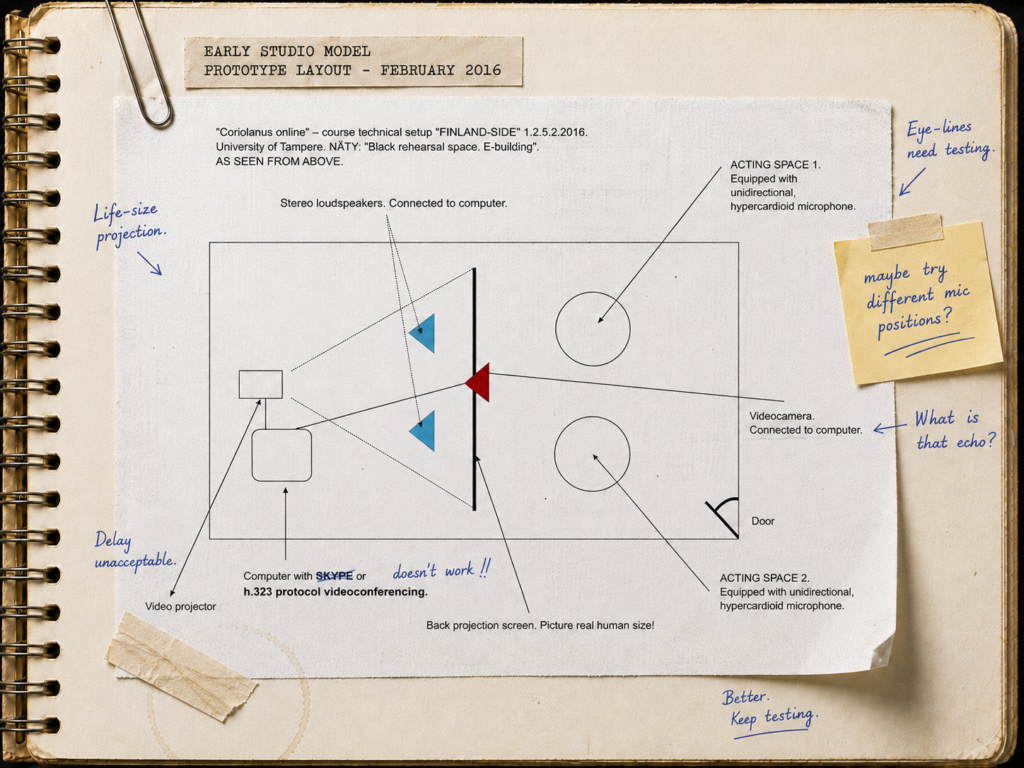
An earlier installation by Coventry colleague Joff Chafer suggested how the space might be configured. Created with Stelarc and Ian Upton at the Herbert Art Gallery in 2012, Extract/Insert connected a physical installation with a virtual recreation in Second Life through large-scale projection. Its spatial arrangement inspired matched rehearsal rooms in Coventry and Tampere using rear projection, aligned cameras, directional sound and similar lighting.
Neither location had been designed for international actor training. Coventry occupied a disused university wind tunnel that offered enough space for life-size projection but produced severe echo and feedback, while Tampere worked from a black-box studio. Much of the equipment was borrowed or repurposed.
Coriolanus Online began in January 2016 as a focused exploration of Act III, Scene III, repeated by mixed groups in Finnish and English. A remotely led Finnish folk-dancing class demonstrated the potential for physical ensemble work, although latency and sound problems made other activities difficult. Students adapted familiar exercises and found creative ways to use the cameras, screens and delay.
The main studios were supported by Adobe Connect, before Zoom became commonplace. It hosted contextual sessions and provided smaller rooms where students could rehearse, work on pronunciation and develop ideas independently. These rooms also became informal social spaces, culminating in a “virtual beer” shared by students in Coventry and Tampere. Facebook provided a further space for schedules, research and rehearsal material.
Although Coriolanus Online included Finnish, most of the project was conducted in English, as were the later collaborations with Finland. Attention moved towards how performers could share space through a screen, form an ensemble at a distance and prepare to work together physically. Telepresence had begun to support embodiment, experimentation and genuine social connection as well as rehearsal.
Learning With Tampere
King Lear Online followed in 2017 and established much of the structure still used today. After two weeks of telepresence rehearsal, the Coventry students joined the Tampere cast for a week in Finland. They arrived with relationships, performance choices and a shared working vocabulary already created remotely.
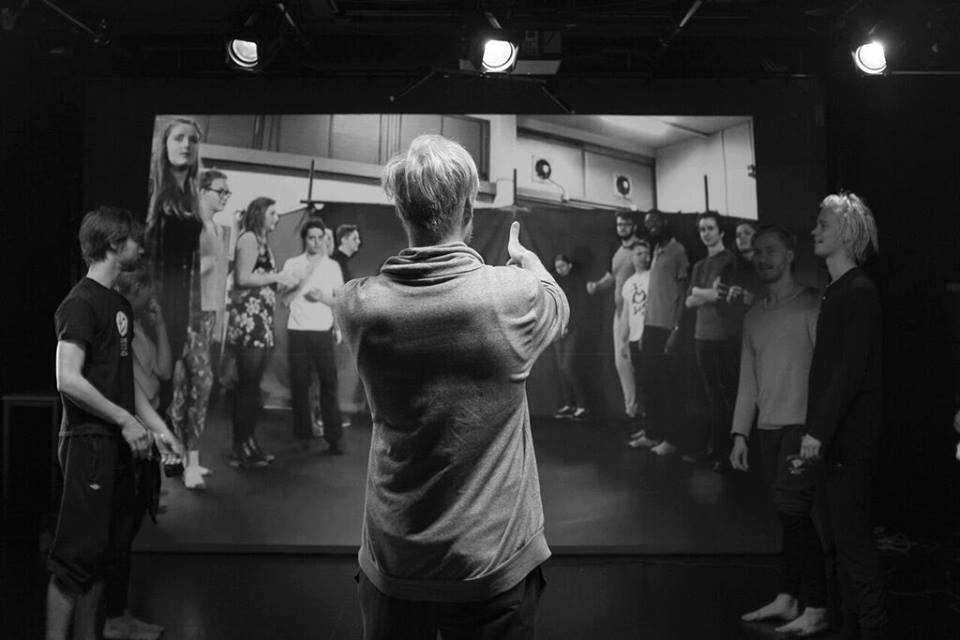
The technology had also improved. Coventry moved from the echoing wind tunnel into an acoustically treated studio, projection changed from 4:3 to 16:9, and better research-network connections substantially reduced the delay. With fewer technical distractions, students could explore how scale, voice and the camera might create intimacy between separated performers, particularly in scenes involving Gloucester and Edgar, and Lear and Cordelia.
The project culminated in a performance of selected King Lear scenes at Telakka Theatre. The Finnish hosts also organised a cultural programme, most memorably sauna and ice swimming. The residency was not where the work suddenly became “real”, but where an existing ensemble deepened its relationships through performance, place and shared experience.
Later that year, a Telepresence Banquet supported Coventry’s successful bid to become UK City of Culture 2021. An identical meal was served simultaneously in Coventry and Tampere, making the connected venues appear as two halves of one dining room. The cities’ mayors spoke across the link while guests watched students perform King Lear scenes between the locations.
By the end of 2017, the partnership had established a central principle: remote rehearsal should not merely imitate physical practice or prepare students for travel. It should create relationships, artistic choices and shared responsibility that can be tested and deepened when performers meet.
International Expansion
In 2018, Twelfth Night Online added the Theatre Academy at the University of the Arts Helsinki and the Academy of Music and Drama at the University of Gothenburg. Students from four institutions explored selected scenes remotely before the Coventry group travelled to Tampere and Helsinki for workshops, social activities, theatre performances and museum visits. International exchange was becoming broader than the production itself.
The same year brought two international showcases. At the GREAT Festival of Innovation in Hong Kong, the Coventry and Tampere team demonstrated material developed for King Lear Online. The following month, a separate professional performance of Sam Shepard’s Paris, Texas opened the Network Performing Arts Production Workshop in Miami. A Nimbra media server developed by Net Insight transmitted video, sound and motion-capture data between a digital performer and musician in Tampere and a live actor at Miami’s New World Center. These showcases tested new possibilities but were not additional student curriculum projects.
New educational partnerships followed in 2019. Coventry and Adam Mickiewicz University in Poznań rehearsed Julius Caesar remotely before completing and performing selected scenes in Poland. A later, entirely online collaboration with Purdue University explored Brecht’s The Life of Galileo, combining shared rehearsals, guest-led workshops and coordinated performances in Coventry and West Lafayette.
By the end of 2019, Immersive Telepresence in Theatre had become an international rehearsal network adaptable to different texts, teaching traditions and institutional settings.

Brexit, Lockdown and Unfinished Projects
Erasmus+ had provided the mobility and European framework needed to bring students together. Following Brexit, Coventry lost access to that support. Funding became less certain, equipment continued to age and collaborations increasingly depended upon smaller institutional contributions, staff time and the determination of participants.
In March 2020, Coventry and Tampere began rehearsing Beckett’s Waiting for Godot using a Nimbra media server developed by Net Insight and professional Blackmagic Design studio cameras. The system improved stability and audiovisual quality while reducing the delay to approximately 40 milliseconds. It was also expensive, complicated and dependent upon specialist knowledge. Later projects returned to less sophisticated Polycom equipment because it was more affordable, dependable and easier for new partners to adopt. The most advanced technology was not necessarily the most useful educational choice.
The casts completed the remote phase and were ready to continue the production together in Finland. The cancellation came the day before the Coventry students were due to travel. Their bags were packed and preparations in Tampere were complete when rapidly developing news in both countries made the journey impossible. Borders closed and campuses entered lockdown, leaving a project about waiting and uncertainty suspended by circumstances no one had anticipated. The groups had created work together but never met physically, and still have not occupied the same room.
The pandemic made remote acting classes commonplace, but it also revealed the difference between emergency video teaching and the environment developed through Immersive Telepresence in Theatre. Life-size bodies, directional sound and carefully constructed eye-lines created a presence that a grid of Zoom windows could not reproduce.
After a pause in 2021, Coventry and Tampere reunited remotely in 2022 for Martin Crimp’s Attempts on Her Life. Daily testing, illness and isolation required continual changes to the cast, but the collaboration survived. It became the final student project in the formative Coventry-Tampere partnership, seven years after the first planning meeting in Finland.
Across The Atlantic
In 2023, Coventry partnered with Florida International University in Miami on Pericles. The play’s journeys across water, separation and reunion reflected the experiences of a cast whose family histories crossed countries and oceans. After two weeks of remote rehearsal, the Coventry students travelled to Florida to complete and perform selected scenes at FIU’s Studio Theatre, with the performance also livestreamed.
The project was artistically ambitious, but it exposed a limitation in the model. Transatlantic travel placed a considerable financial burden on students, while a shared language, familiar cultural references and few locally rooted activities allowed the visiting group to fall back upon recognisable habits. This was not a judgement on Miami’s diversity, but evidence of a weakness in the design: international travel does not automatically produce intercultural learning.
By 2023, the technology had repeatedly proved that performers could collaborate across distance. The next phase needed to ask how language, place and local culture could become active parts of the rehearsal process and the students’ experience outside it.
Shakespeare Remote in Mallorca: A New Beginning
The relationship with L’Escola Superior d’Art Dramàtic de les Illes Balears offered an opportunity to renew the project while returning to an early, largely unfulfilled ambition. Only Coriolanus Online had included a substantial Finnish-language element; bilingualism had never shaped an entire process from casting to performance.
The ESADIB partnership began through an Erasmus exchange in 2022, when Pau Cirer visited Coventry. Further meetings in Palma brought together Tom Gorman, designer Kieran Steward, Pau Cirer, Biel Jordà and Fanni Marí. Both institutions agreed that language would shape the artistic and educational process, not be managed as an inconvenience or added for decoration.
That decision carried particular significance in Mallorca, where tourism often obscures a distinct cultural and linguistic identity. Catalan, in its Mallorcan form, remains central to that identity. The collaboration therefore needed to be grounded in local language, knowledge and experience.
Romeo and Juliet Online in 2024 became the first project to make bilingualism a sustained rehearsal and performance method. Shakespeare’s English was combined with Catalan translations by Miquel Desclot and Josep Maria de Sagarra. Every participant worked in a second language at some point: Coventry students depended upon ESADIB partners for pronunciation, meaning and cultural knowledge, while ESADIB students encountered the demands of Shakespeare’s English. Neither group could claim complete authority, and both had to take risks and help one another make the text work.
After two weeks of remote rehearsal, the students met in Palma for an in-person residency and public performance in ESADIB’s courtyard. Relationships and artistic choices developed through the screen carried into the shared physical space, where breath, proximity and direct eye contact intensified work already underway.
The Mallorca phase recovered the linguistic ambition behind the first conversations in Tampere and realised it as a complete educational method. Bilingualism became a way to exchange knowledge, negotiate authority and share ownership.
The name Shakespeare Remote emerged without a formal relaunch or attempt to separate the new work from its history. It described what the project had become: an exploration of how Shakespeare could bring students together across linguistic, cultural and physical distance. Immersive Telepresence in Theatre remained its foundation.

A refocused International Experience
The ESADIB partnership continued with As You Like It Online in 2025 and the tenth-anniversary production of The Comedy of Errors in 2026. Each project increased the scale of the work. Romeo and Juliet Online used approximately 60 per cent of Shakespeare’s play, while As You Like It Online used around 70 per cent. The Comedy of Errors became the first full-length, unedited production in the project’s history, performed bilingually in Mallorca and Coventry.
Because the first two weeks take place at each student’s home institution, only one week of overseas accommodation and living expenses is required. Repurposed equipment also keeps the approach practical for institutions with limited resources. The model does not remove every financial barrier, but it allows students to access a sustained international performance experience that might otherwise be beyond their reach.
Repeated visits, continuing conversations and close relationships with ESADIB colleagues gave the Coventry team a growing first-hand understanding of Mallorca and the pressures it faces. The project cannot resolve the effects of mass tourism on housing, public space, natural resources and everyday life, nor can visiting students speak for the island. It can build these concerns into the experience, asking students how they arrive, whose knowledge they value and what relationship they establish with the place.
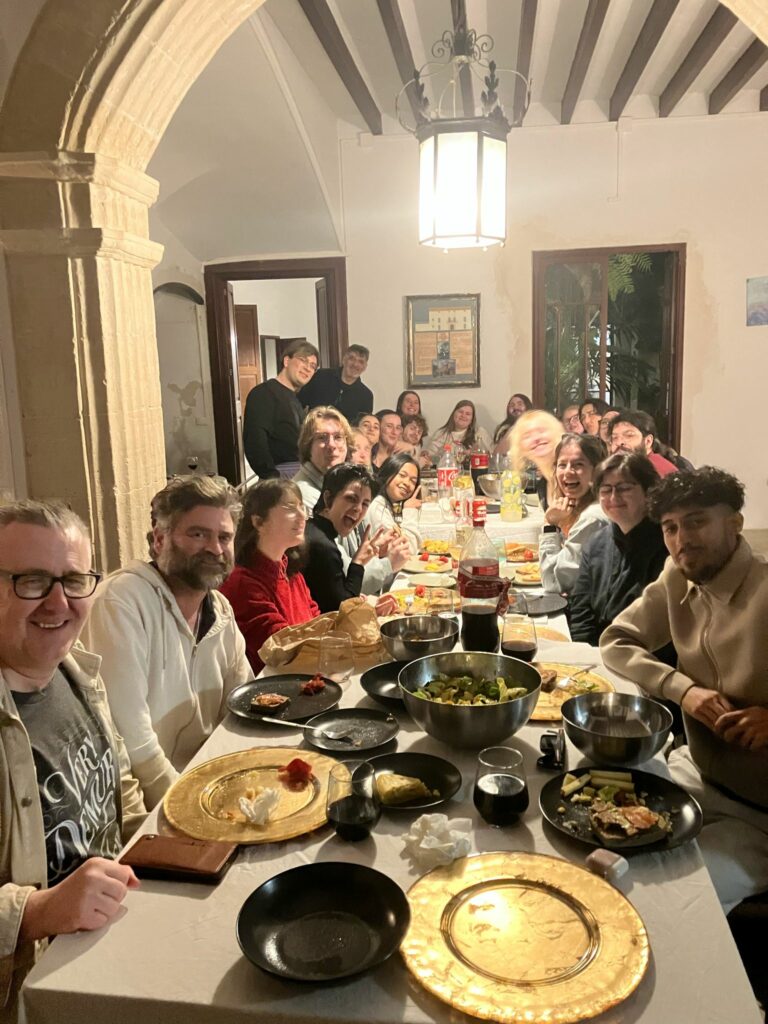
Cultural activities are therefore part of the learning, not tourism around the edges of rehearsal. In 2025, ESADIB hosts welcomed the company to Sineu, where students prepared traditional Mallorcan food and shared pa amb oli around a long table. Time with local students, informal evenings sharing food and visits around the island allowed relationships to develop beyond staff-led sessions, strengthening the trust upon which the bilingual work depended.
Projects are scheduled outside the peak tourist season where possible, with performances in local venues for local audiences. The exchange also runs in both directions: for The Comedy of Errors, ESADIB students and staff travelled to Coventry to rehearse and perform. Mallorca is not a backdrop to a British student experience, but the home of an equal partner whose knowledge and concerns shape the collaboration.
Students as Co-Creators
Each production changes what follows. Student feedback has led to scripts and casting being shared earlier, more language preparation and low-pressure meetings before the main rehearsal period. Once rehearsals begin, students use their own WhatsApp groups to exchange pronunciation guidance, discuss scenes and arrange additional rehearsals without staff involvement. What begins as a staff-designed project gradually becomes a space shaped and owned by its ensemble.
The clearest evidence of ownership is that students return. Six members of the 2026 company were participating for a third year, contributing as directors, stage managers, language facilitators and experienced peers. They established the Graduate Organising Committee to support new students, contribute to future planning and carry knowledge between successive cohorts. Shakespeare Remote has become an international community that students choose to sustain and increasingly lead.
Over time, the project has become something close to a place: a shared rehearsal room that does not physically exist, but one that students and staff continue to find their way back to. It has no permanent walls or address, yet it holds the memories, relationships and working practices accumulated through ten years of collaboration.
Looking to the Future
Across eleven student projects, Shakespeare Remote has developed performers who listen closely, communicate beyond words and remain creative when familiar approaches fail. At Coventry, participation is optional and unassessed, giving students the freedom to experiment, make mistakes and take artistic risks without a grade attached. This “freedom to fail” remains central to the project’s identity.
Its reach extends beyond the 247 direct participants through more than 30 presentations across four continents, five publications, workshops and an open video archive. A developing toolkit will share approaches to remote ensemble-building, bilingual rehearsal, affordable exchange and student ownership with schools, colleges, youth theatres and other drama programmes. It will help others adapt the learning to their own students, languages, communities and resources rather than export one fixed formula.
Shakespeare Remote remains active within the Network Performing Arts Production Workshop and Remote North. Future projects will respond to changes in technology, funding and education while protecting the principles established over ten years: sustained remote rehearsal, meaningful physical exchange, respect for local language and culture, and increasing student ownership.
The project’s original technical question has been answered. Students can rehearse and make theatre together across distance. Shakespeare Remote now explores what performers learn by working across languages and cultures before they share the same room.
Milestones
- June 2015: First Coventry-Tampere planning meetings…
- January-February 2016: Coriolanus Online
- December 2016: Telepresence in the Arts Workshop
- February-March 2017: King Lear Online and live performance at Telakka Theatre, Tampere
- October 2017: Coventry City of Culture 2021 Telepresence Banquet
- February 2018: University of Tampere Winter Gala
- February 2018: Twelfth Night Online
- March 2018: Interview at the GREAT Festival of Innovation, Hong Kong
- March 2018: King Lear Online performance and discussion at the GREAT Festival, part one
- March 2018: King Lear Online performance and discussion at the GREAT Festival, part two
- April 2018: Paris, Texas professional telepresence showcase, Miami and Tampere
- March 2019: Julius Caesar Online
- May-June 2019: Galileo Online
- March 2020: Waiting for Godot Online
- March 2022: Attempts on Her Life Online
- January-February 2023: Pericles Online
- March 2024: Romeo and Juliet Online
- March 2025: As You Like It Online
- March 2026: The Comedy of Errors Online, performed in Palma and Coventry
- 2026: Formation of the Graduate Organising Committee
1 Pingback