
Galileo Online: performance without travel
Galileo Online developed from a visit by Professor Anne Fliotsos of Purdue University to Coventry, where discussions began about a possible collaboration between the two theatre departments. Instead of returning immediately to Shakespeare, the partners chose Bertolt Brecht’s The Life of Galileo, a demanding twentieth-century play that presented a different set of theatrical, intellectual and technical challenges.
In May 2019, students from Coventry University’s Theatre and Professional Practice BA began a two-week remote collaboration with staff and participants from Purdue University in West Lafayette, Indiana. The Coventry cast was largely made up of students who had recently completed Caesar Online with Adam Mickiewicz University. Their previous experience meant that they already understood the telepresence space and could concentrate upon developing ideas for the medium instead of learning the system from the beginning.
The Purdue group combined graduate theatre students with participants from other disciplines who shared an interest in performance. Unlike King Lear and Caesar Online, the collaboration did not lead to a physical residency. The groups never occupied the same room. Two performances at the end of the process were presented to invited audiences in Purdue and Coventry, with live actors and projected partners appearing together across the transatlantic connection.
Moving beyond Shakespeare
The Life of Galileo was the first text outside Shakespeare’s work to be explored through the student telepresence projects. The change was not simply a way of introducing variety. Brecht’s theatrical methods and the play’s arguments about science, authority, truth and personal responsibility required both groups to reconsider how they approached performance.
Selected scenes were used rather than the complete play. The two-week schedule demanded an intensive process, particularly because the five-hour time difference restricted the hours in which both groups could rehearse together. The cast had to build scenes around a connection that was available only during a limited part of each working day.
The play also gained different political resonances on each side of the Atlantic. Coventry and Purdue students approached its questions through their respective national experiences, giving later audience discussions a perspective that could not have emerged from a single local cast. The international division was therefore not simply a technical arrangement; it shaped how the play’s ideas were interpreted.
Connecting Coventry and Purdue
Purdue is approximately 4,000 miles from Coventry, making this the project’s first transatlantic student collaboration. The distance, network routing and signal processing produced more noticeable latency than the shorter European connections. Sound and image had to travel between two institutional networks, each with its own firewalls and security arrangements, before being processed by the equipment in the rehearsal spaces.
Purdue borrowed a Polycom system from the dean’s office and used an internal College of Liberal Arts grant to purchase a high-quality projector and short-throw lens. The studio also required a large screen positioned at floor level, speakers and a sound board behind the projection, carefully focused lighting and support from local technical staff to lower firewalls and test the connection.
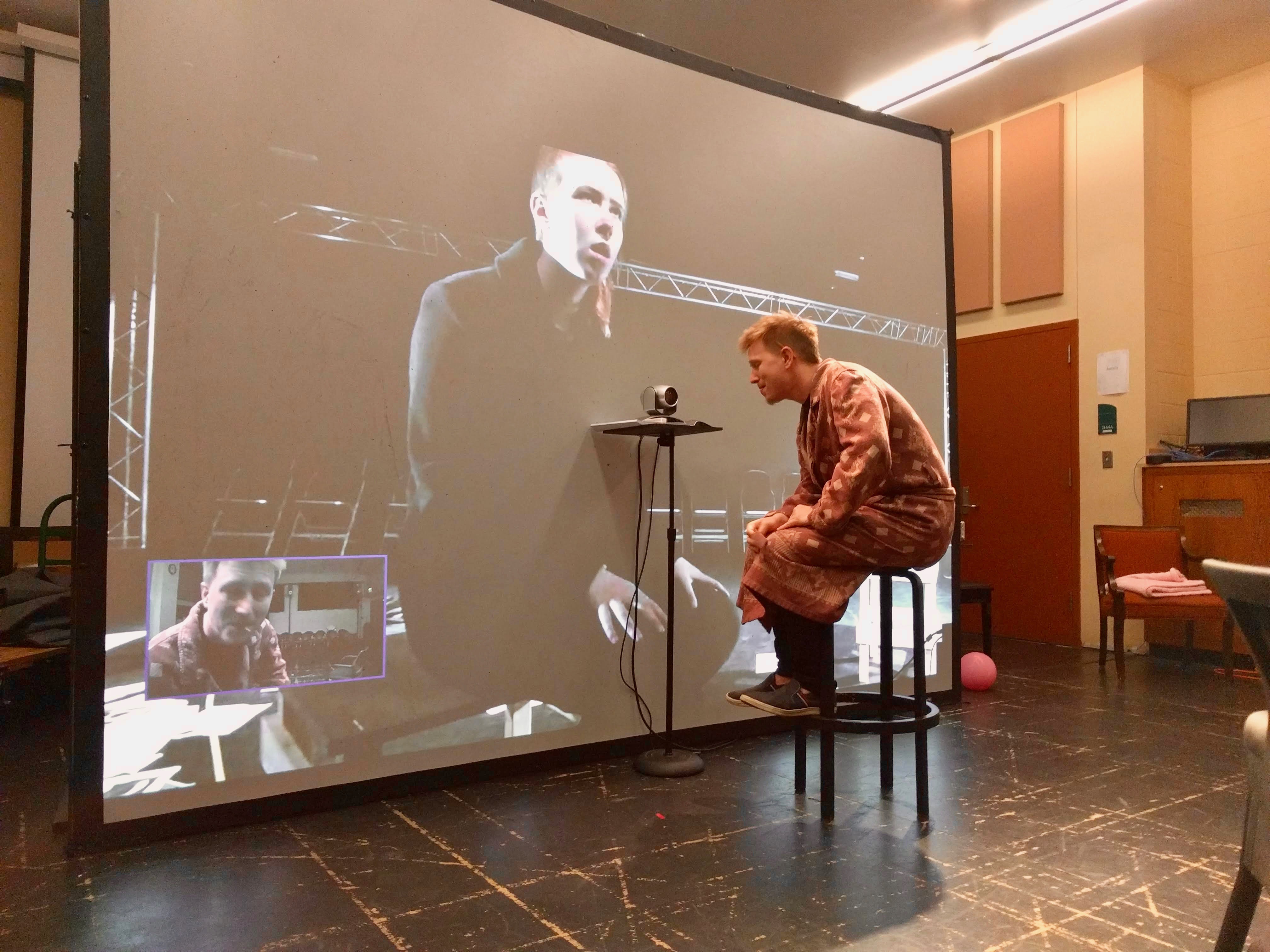
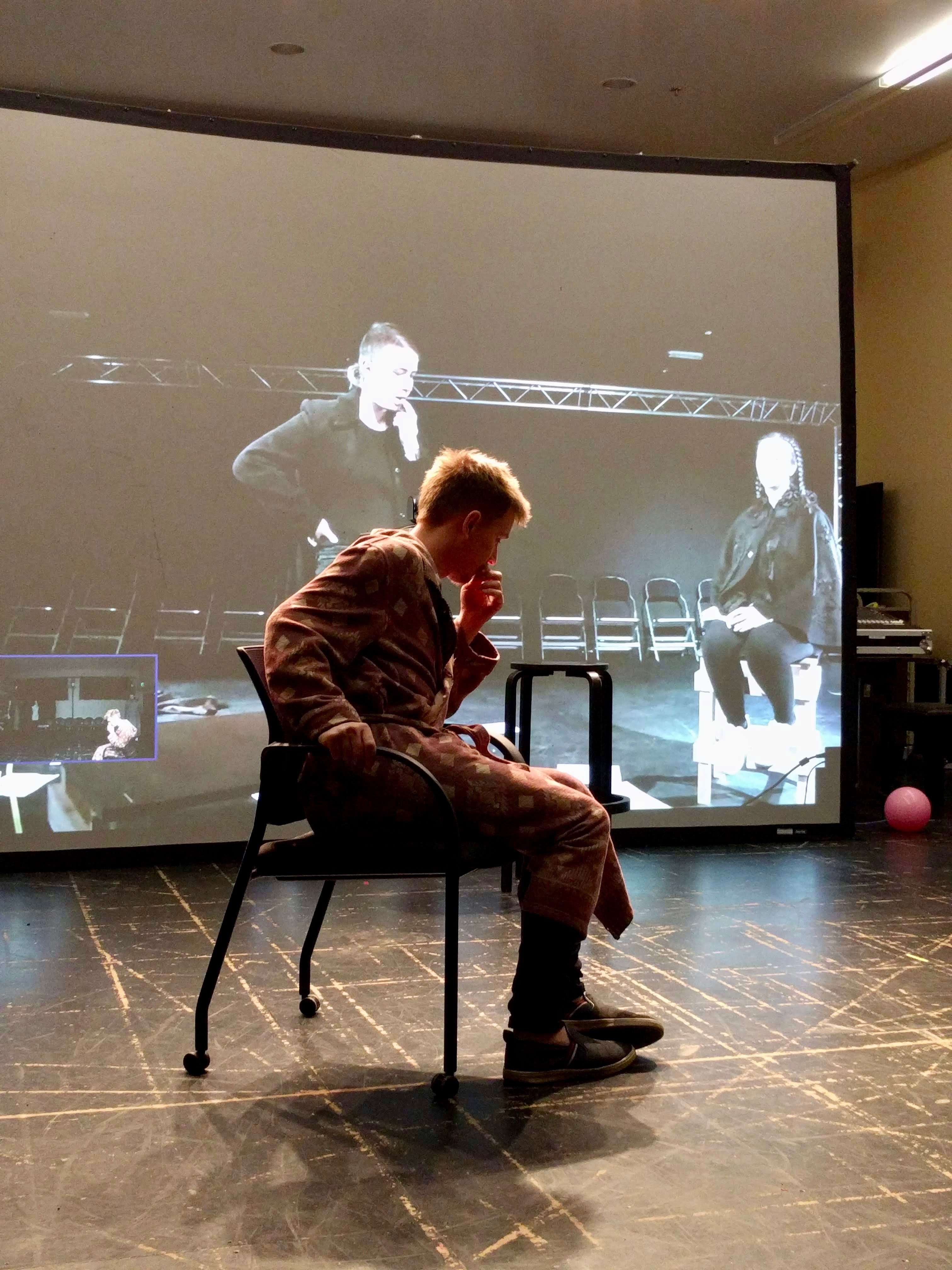
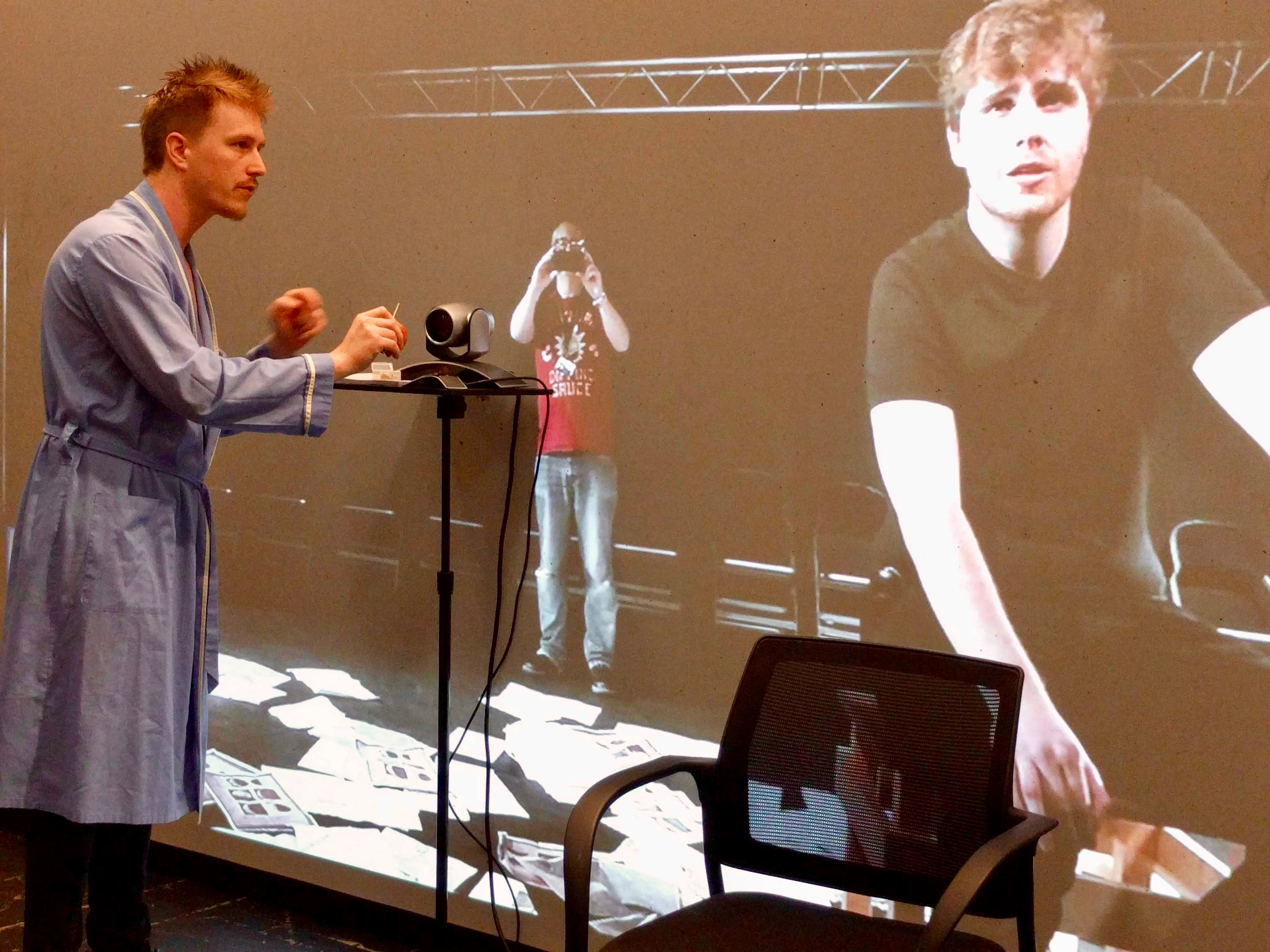
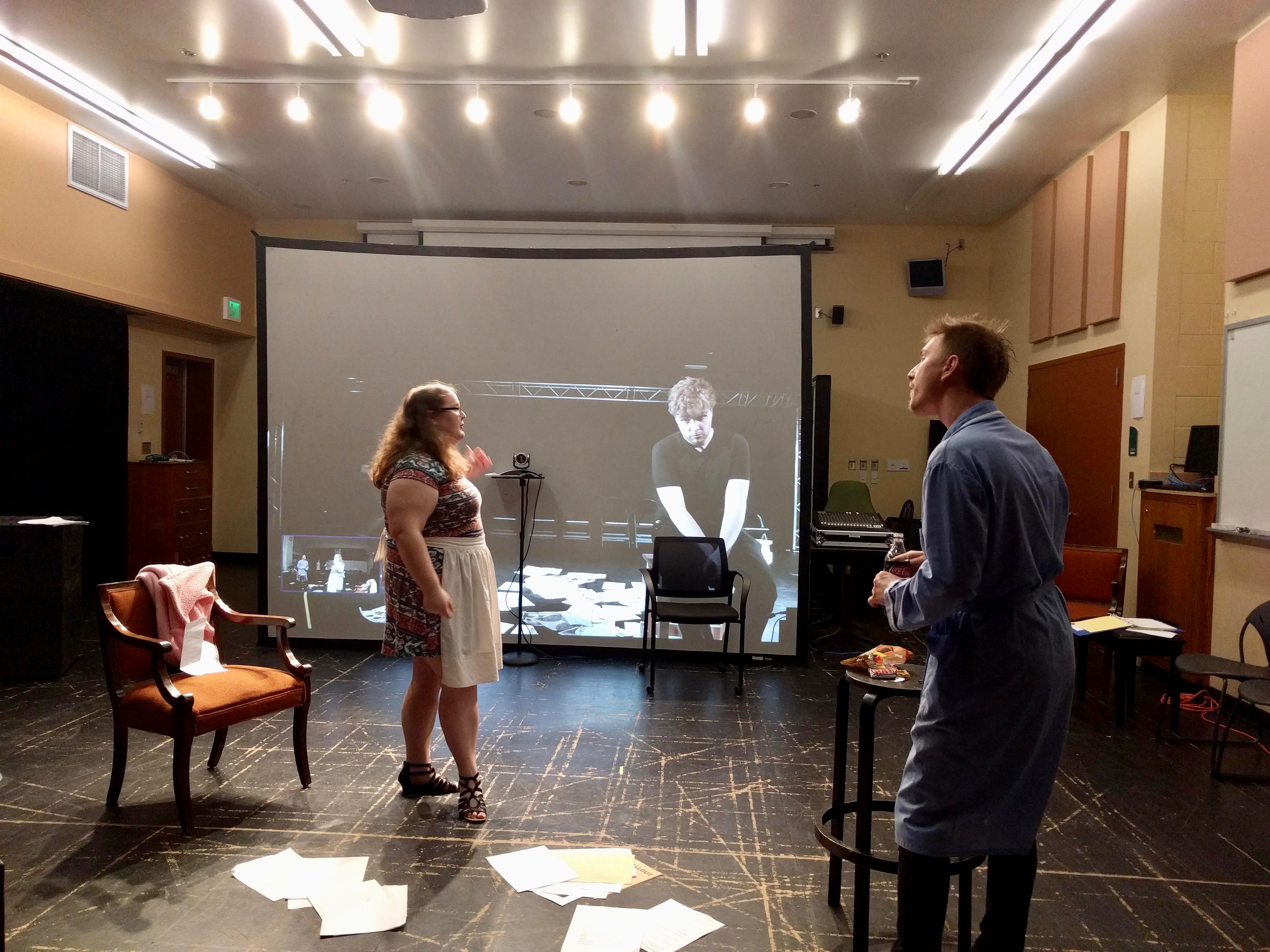
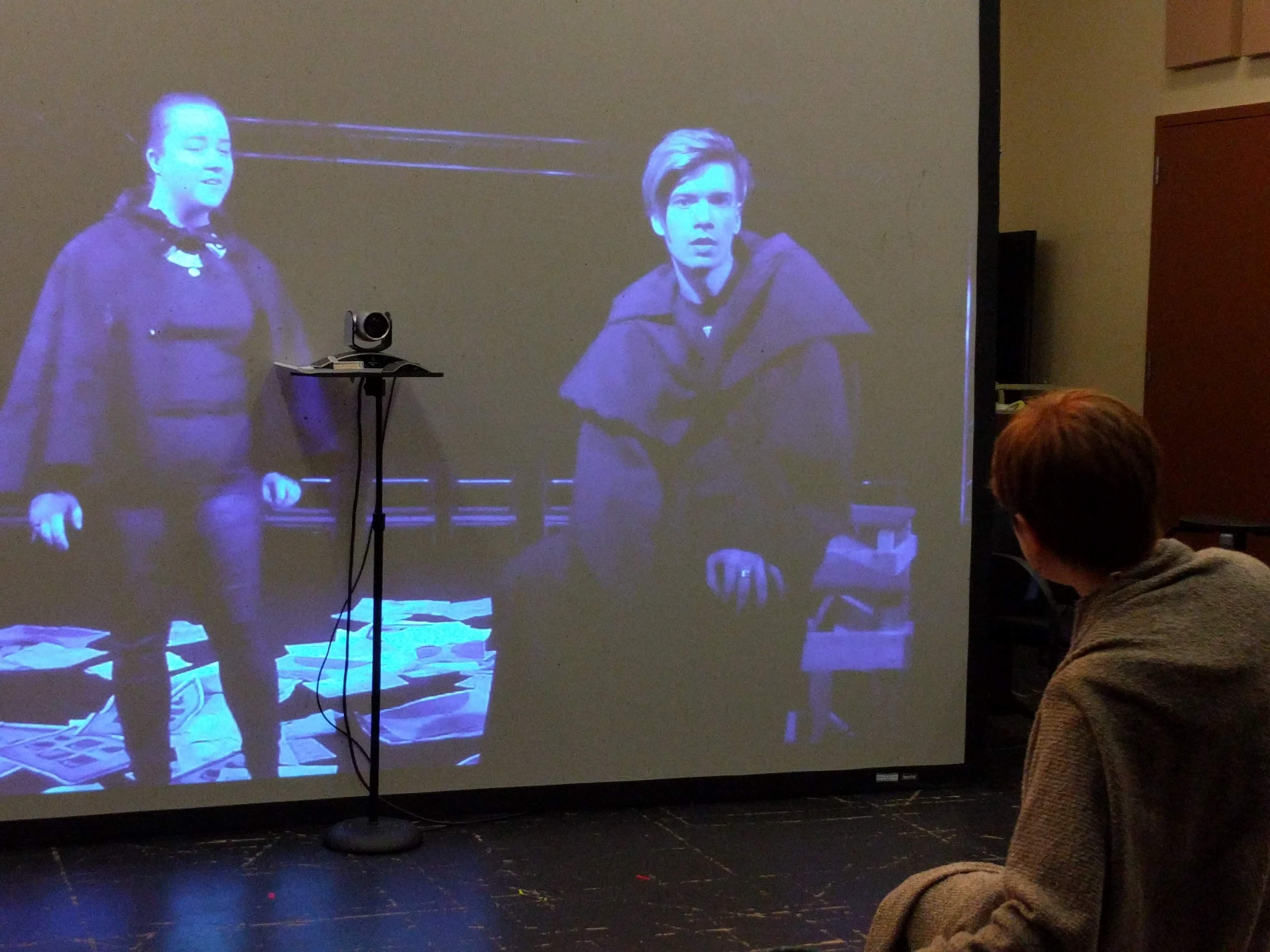
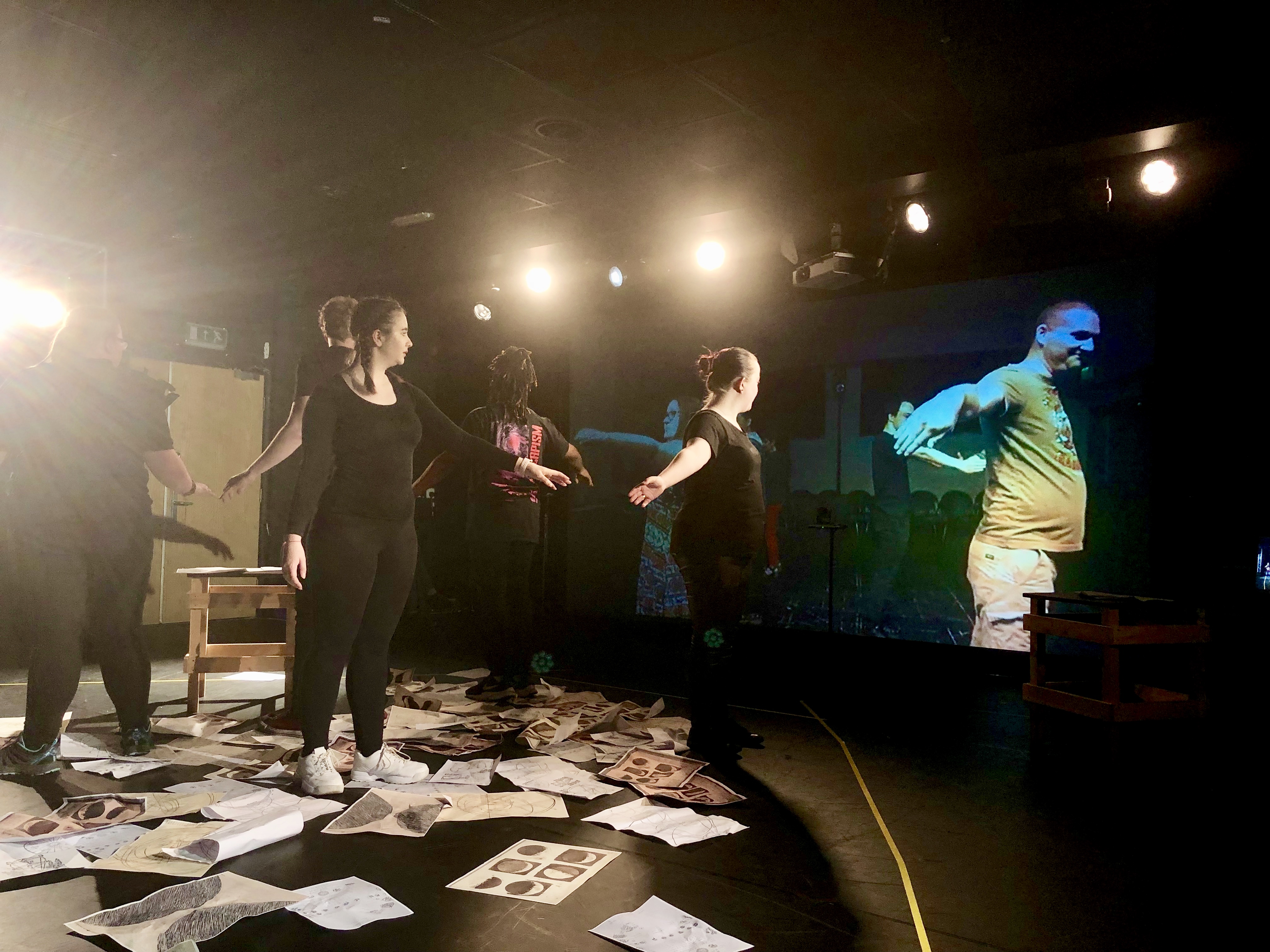
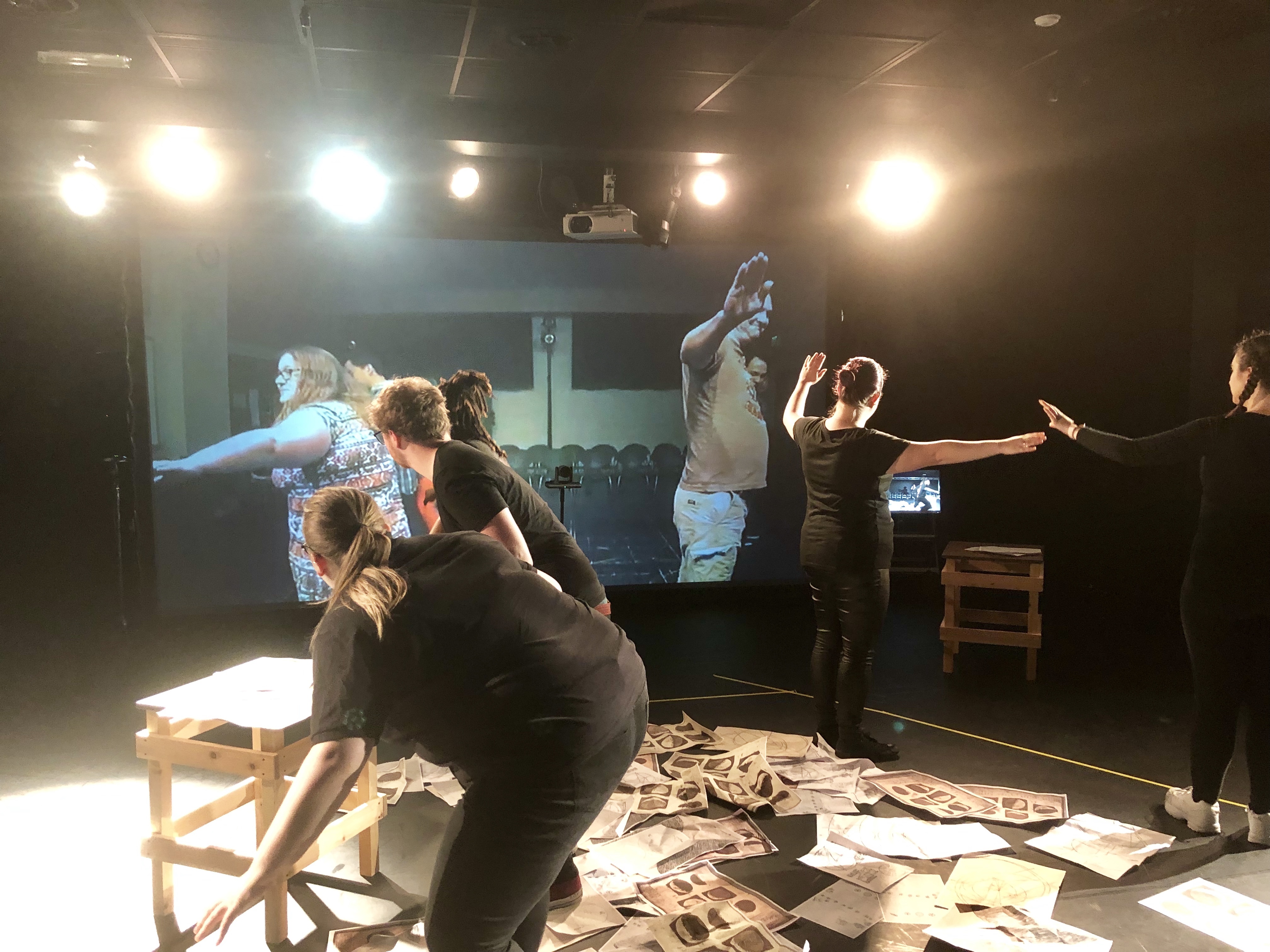
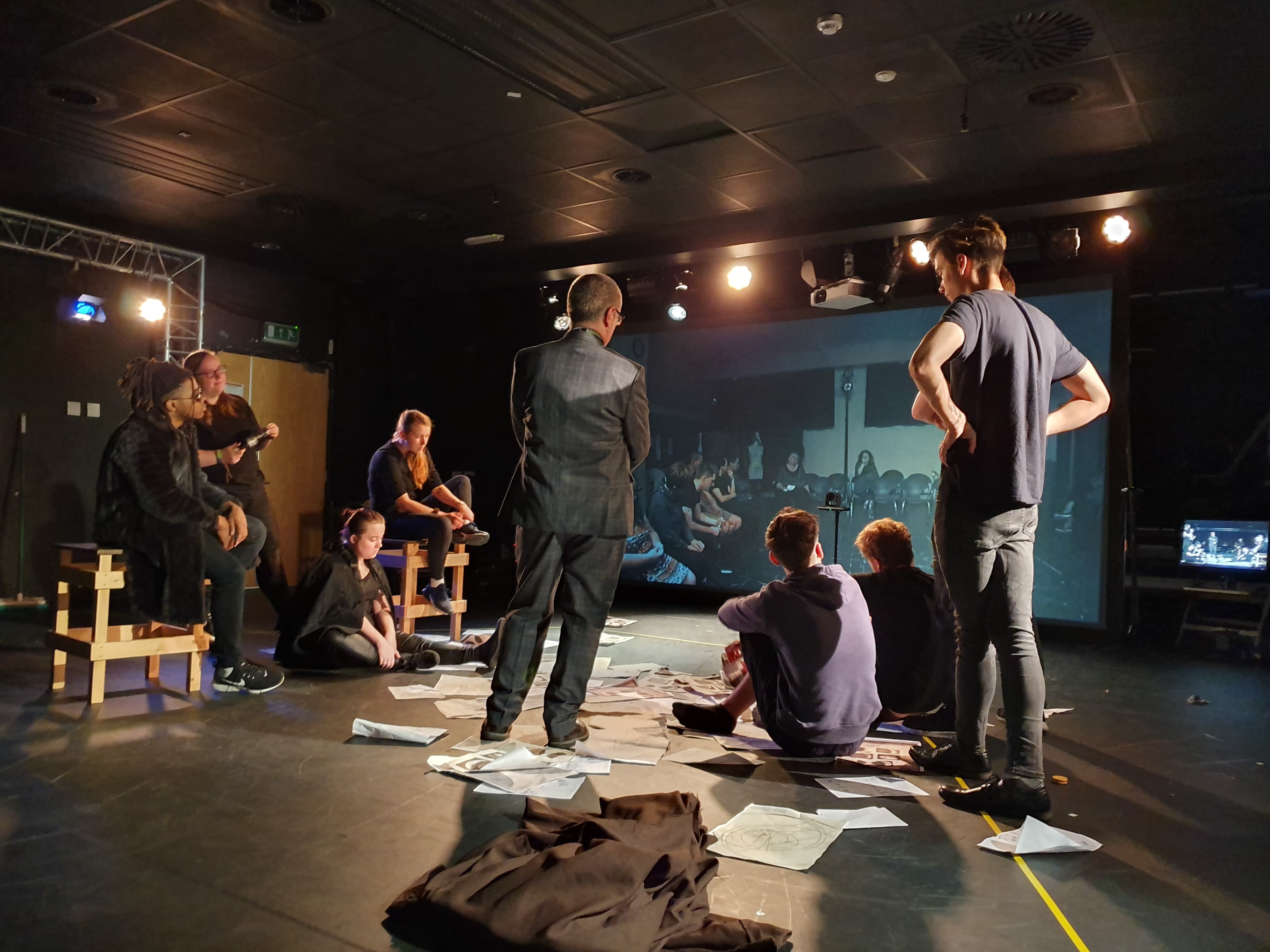
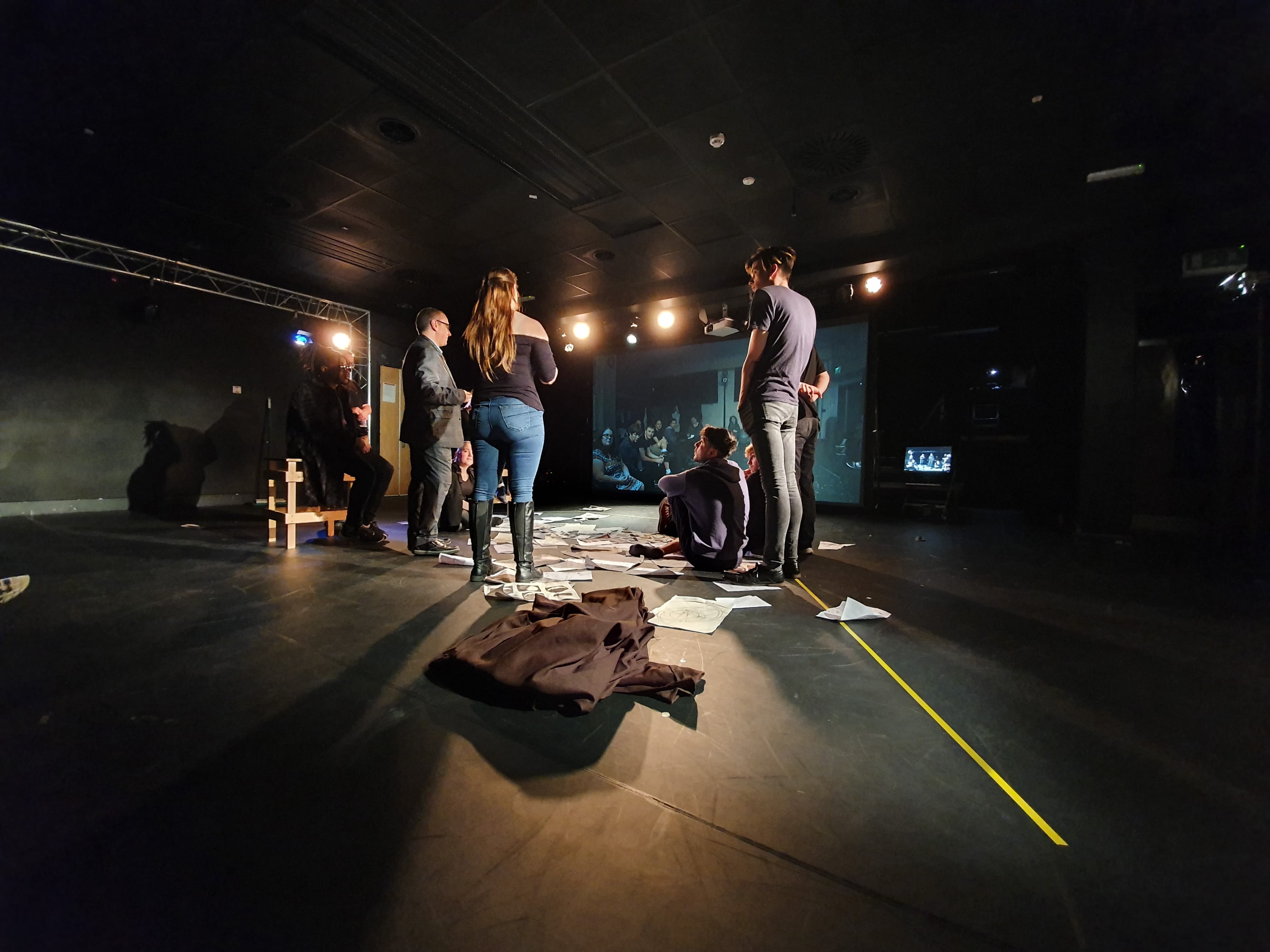
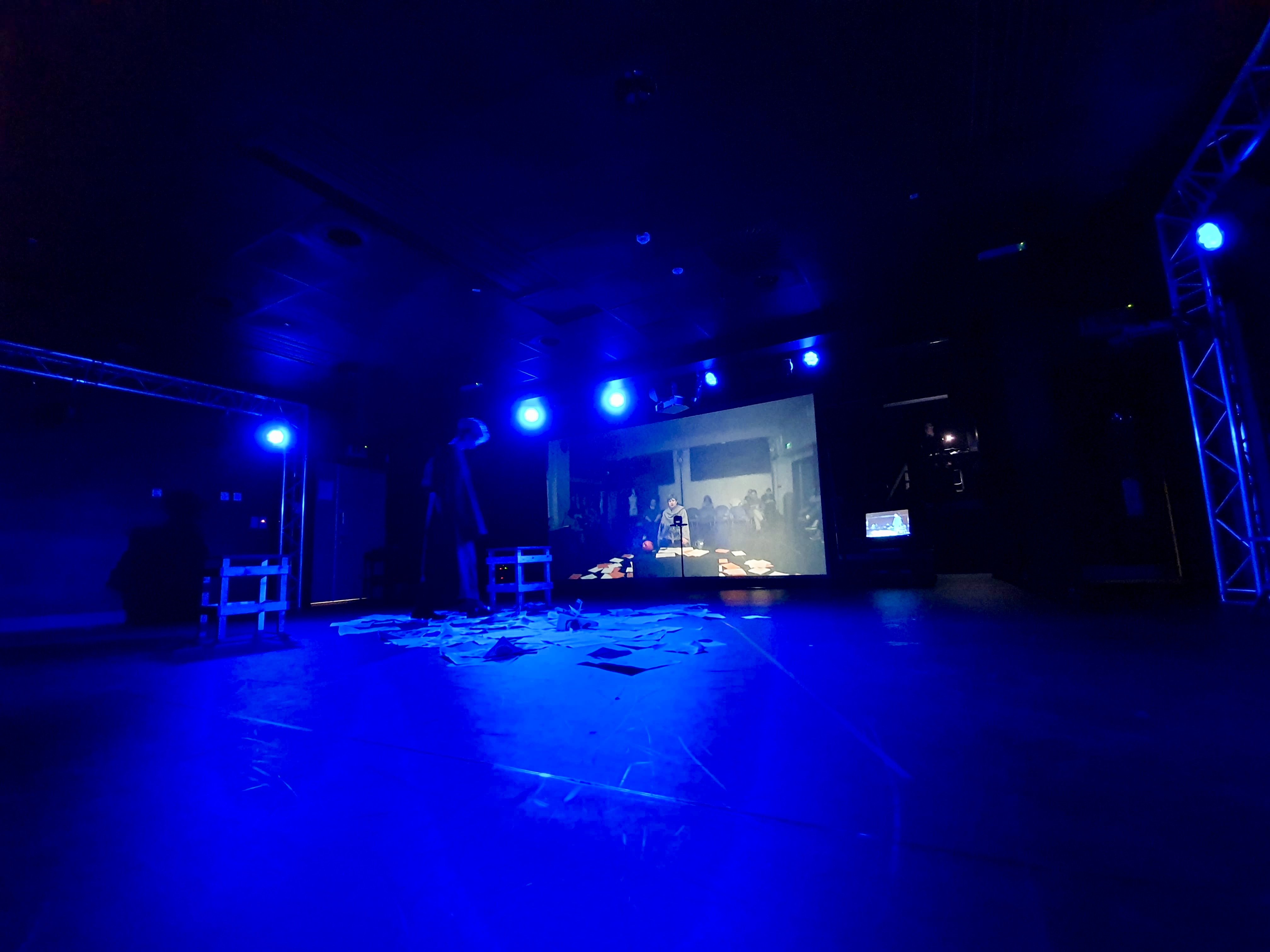
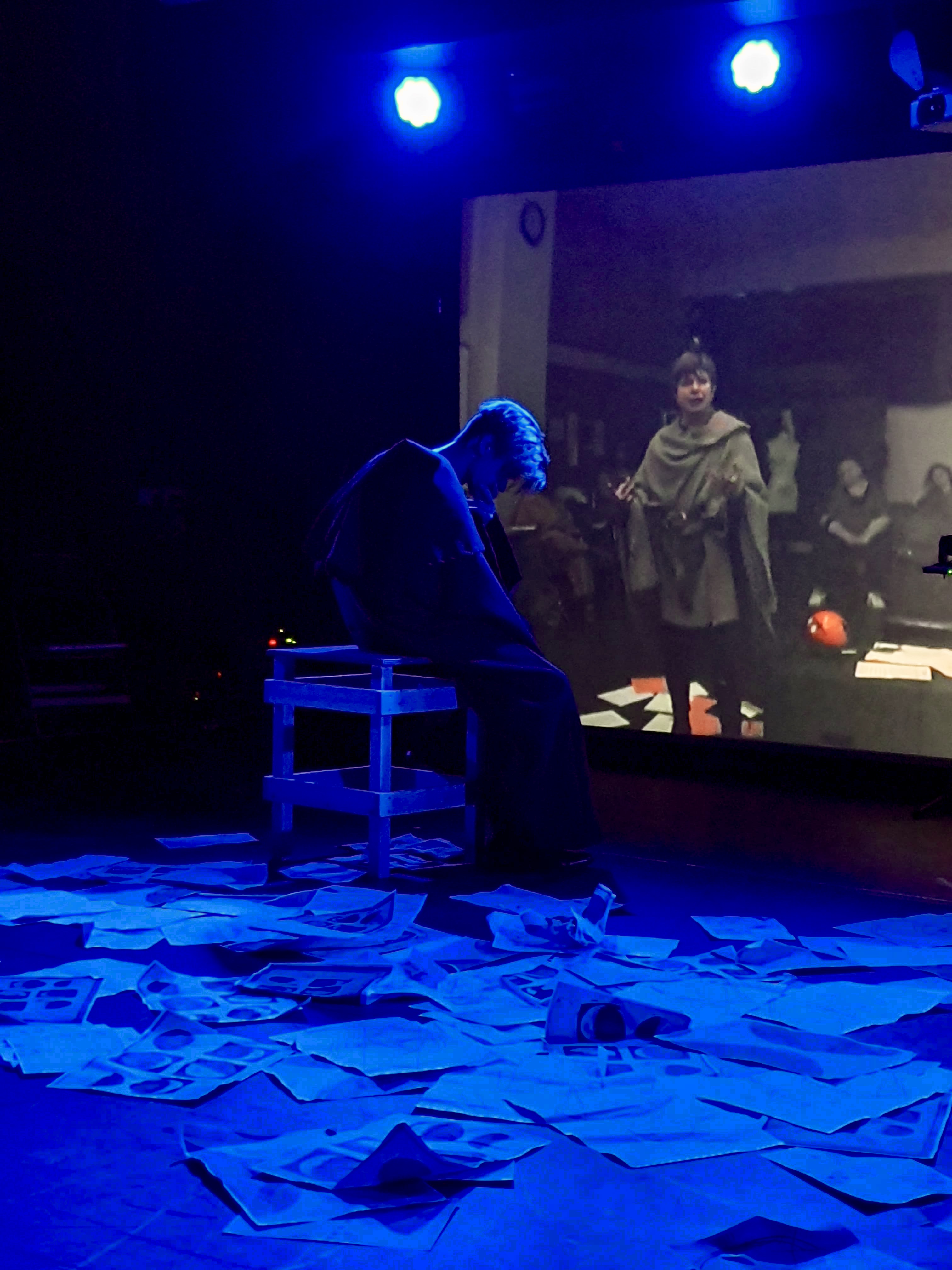
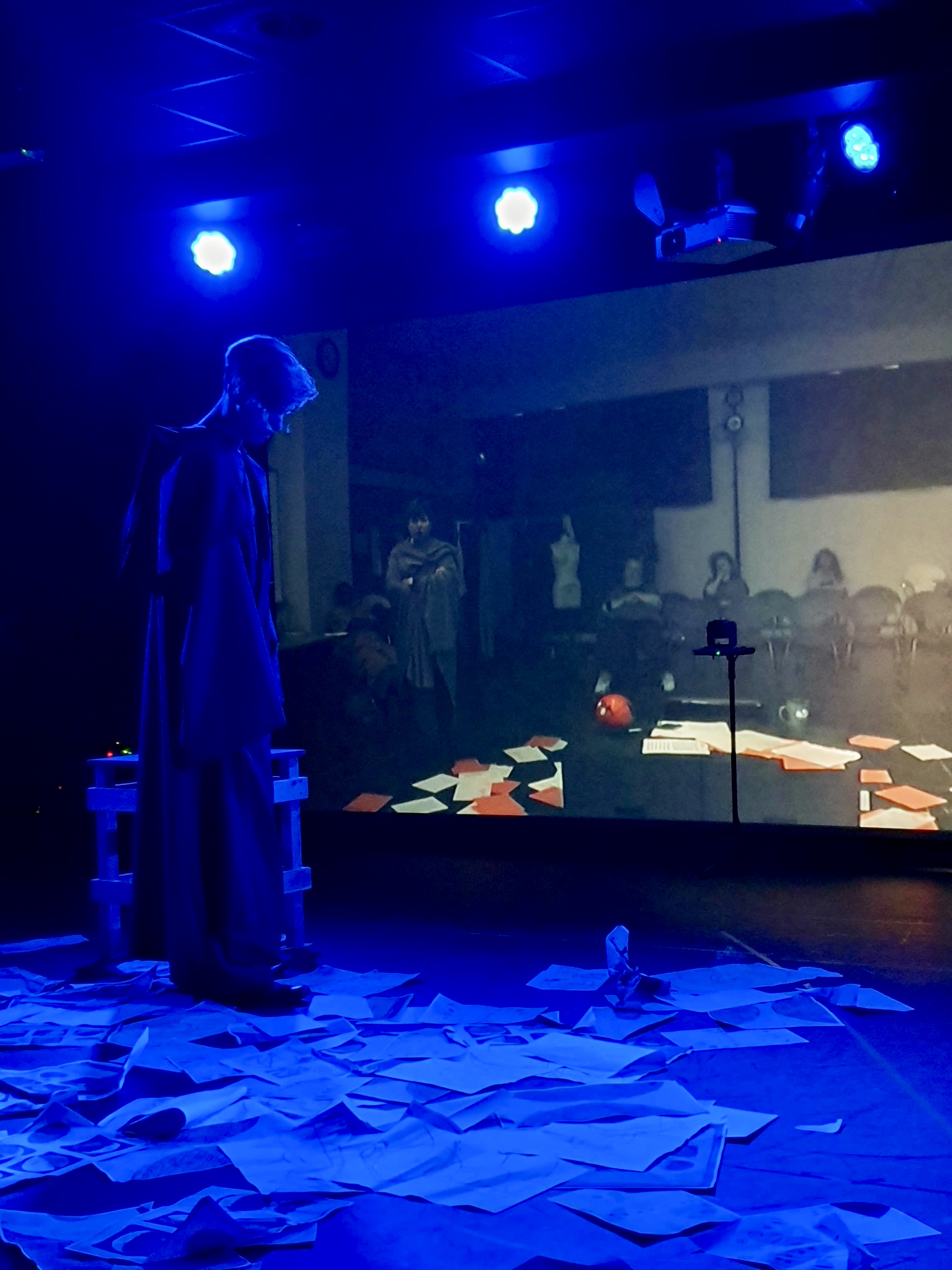
The basic visual arrangement followed the system developed in earlier projects. The camera was placed centrally, the floor was marked to show the area visible to the other side, and actors appeared at large scale within the projected studio. A screen-in-screen display allowed performers and directors to see how the image appeared from the opposite perspective.
The connection was not seamless. Latency complicated timing, regional accents combined with variable sound quality sometimes made Brecht’s text difficult to follow, and rapid movement could blur the projected image. These limitations became part of the rehearsal problem that both casts had to negotiate.
Clowning, burlesque and Brecht
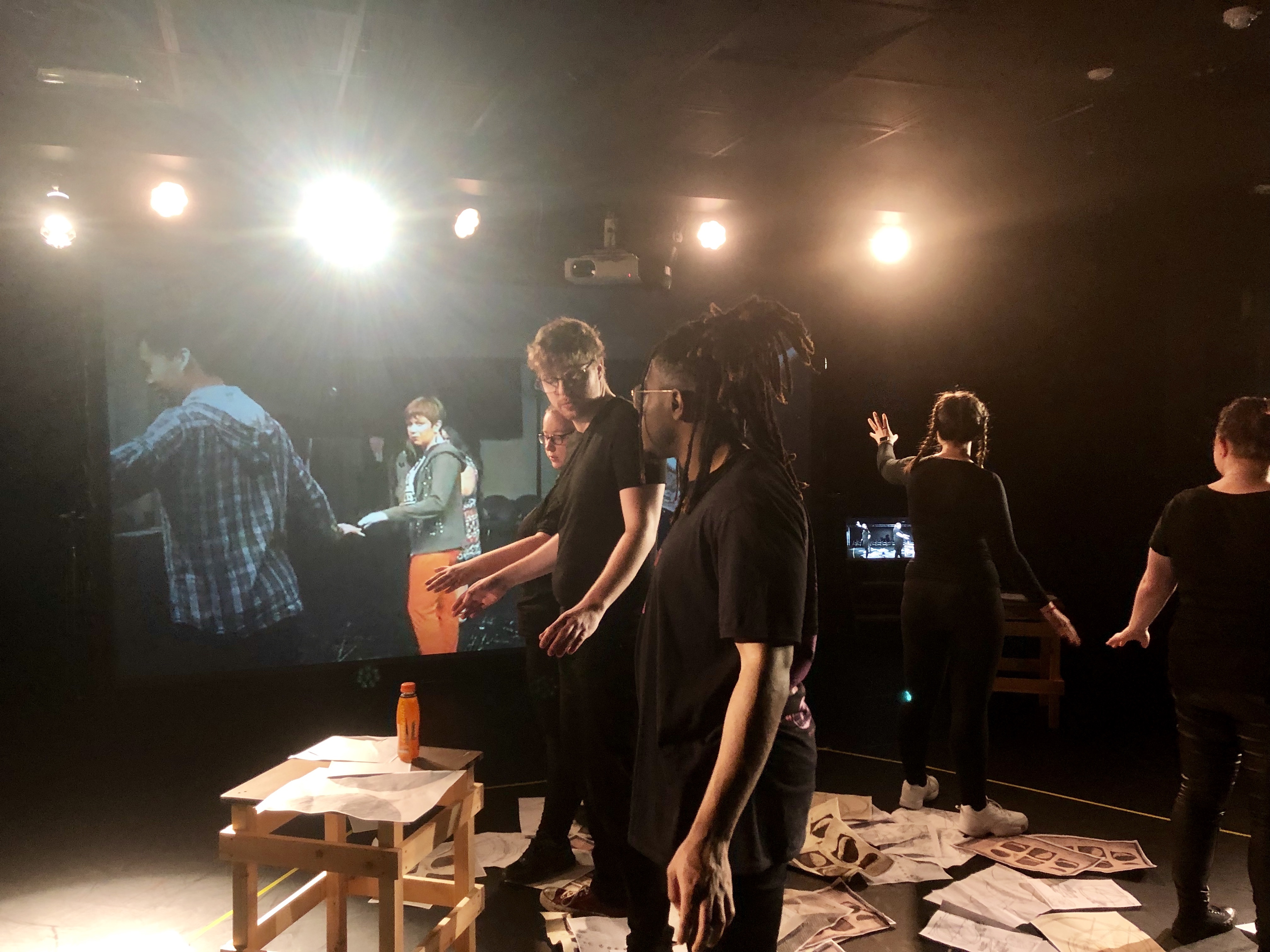
The course combined scene rehearsals with workshops led by practitioners from both institutions. Connor Nolan of Noctium Theatre returned to lead a clowning workshop, Amy Lynn Budd of Purdue introduced the students to burlesque, and Ann M. Shanahan led a session examining Brecht and his rehearsal methods.
These workshops provided contrasting approaches to the play. The Brecht session gave the students a clearer context for his theatrical ideas, while clowning and burlesque encouraged direct communication, physical play and awareness of the audience. The burlesque workshop also allowed Purdue participants to share an aspect of their performance culture with the Coventry group.
The returning Coventry students were able to draw upon the experience gained through Caesar Online. They were already familiar with the delay, the fixed camera and the difference between appearing present in their own studio and appearing as a projected body abroad. This allowed them to develop scenes with greater awareness of how scale and framing could carry meaning.
Composing for a fixed camera
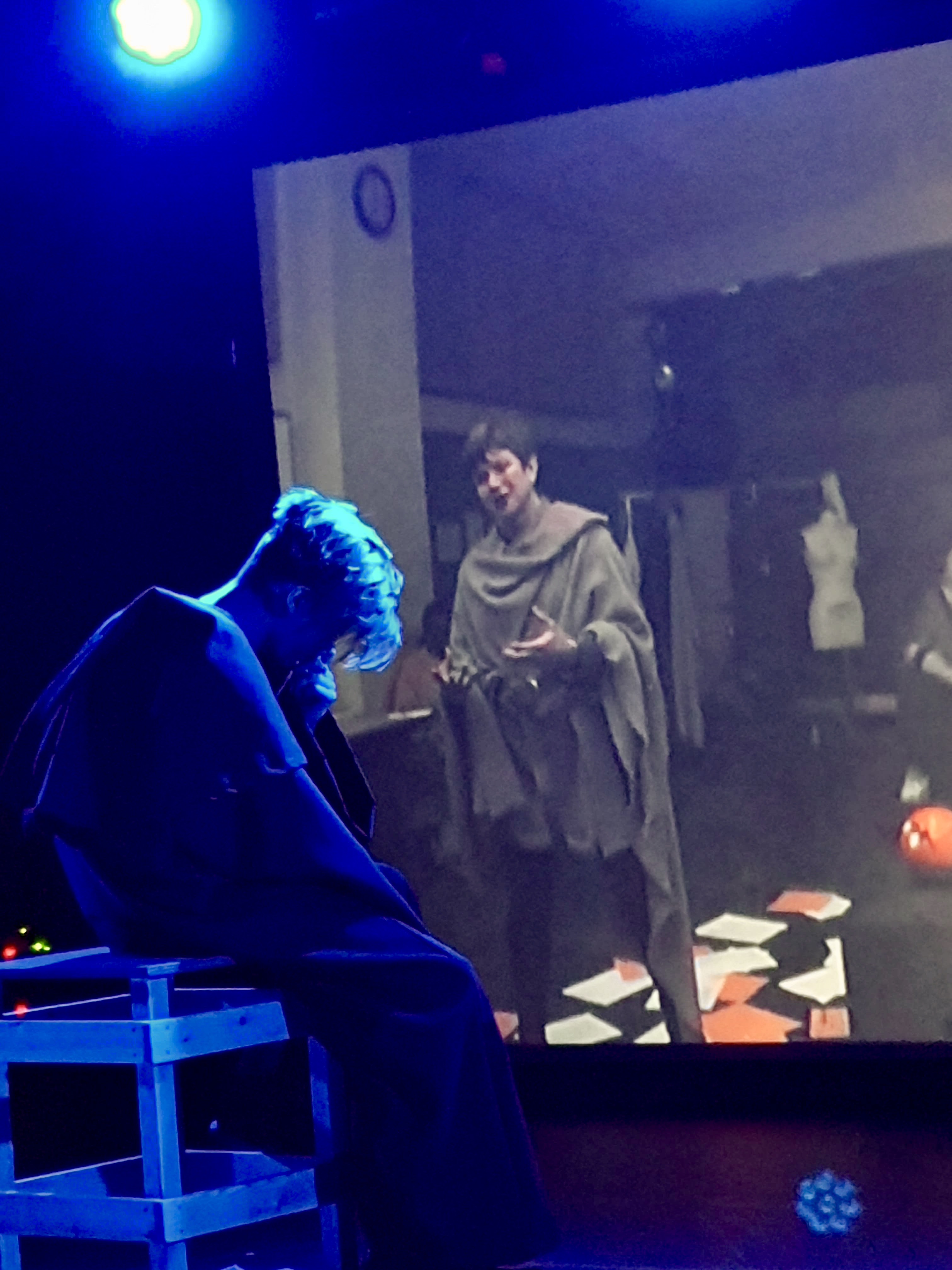
Unlike conventional film production, the telepresence camera did not move or follow individual performers. Actors controlled the image by changing their own position. Approaching the centre of the screen created a close-up; retreating from it opened the frame into a wider view. A performer could therefore alter apparent size and emphasis through movement without the intervention of a camera operator or editor.
Anne Fliotsos later identified one moment from the penultimate scene as a particularly effective use of this quality. As Andrea attempted to repair his damaged relationship with Galileo, he extended a hand across the connection. The hand appeared enormous when projected beside the live Galileo, dwarfing him and turning a simple gesture of reconciliation into an image of scale, distance and unresolved power.

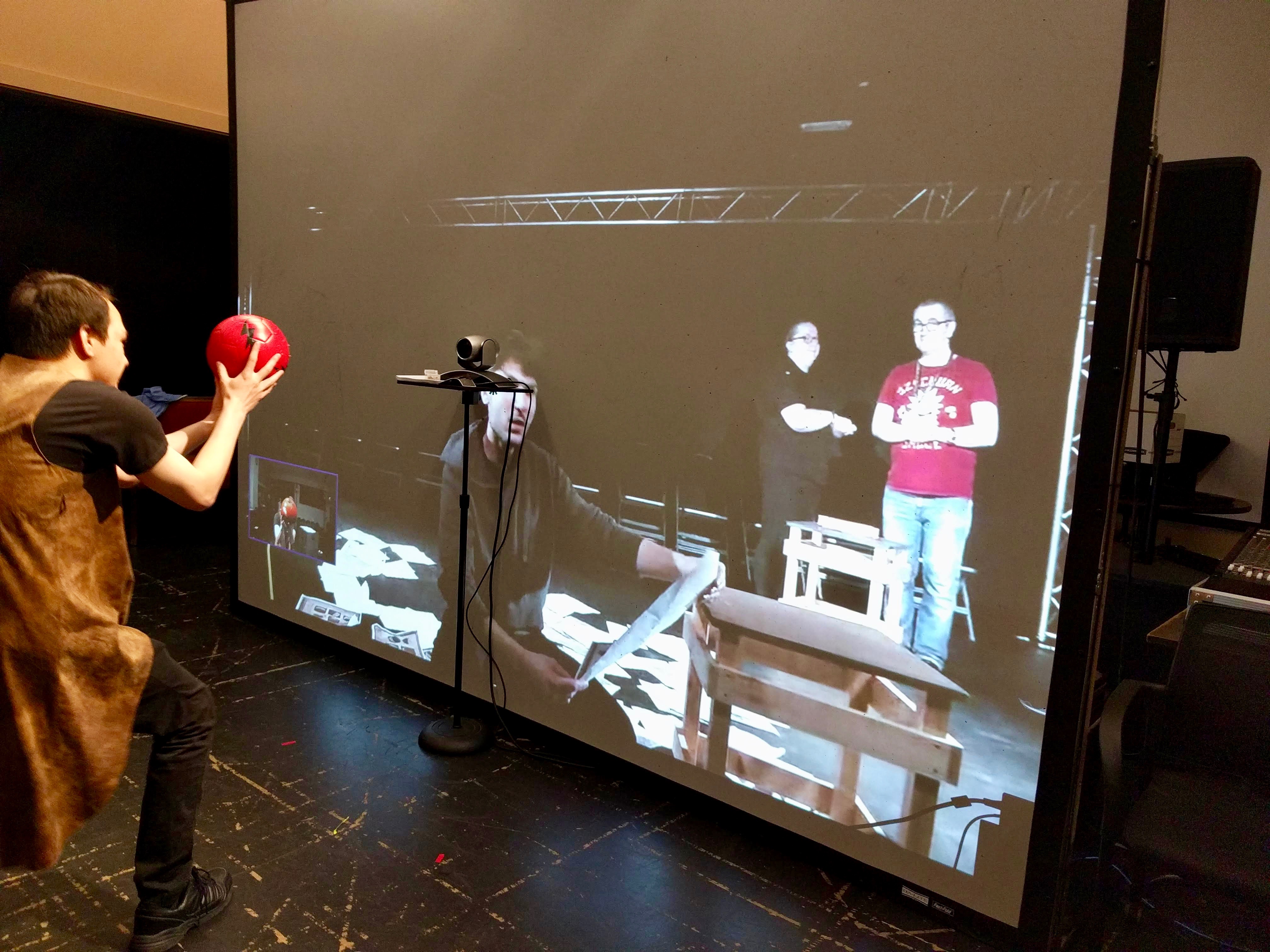
Another sequence used an apple to represent the earth, with the screen-in-screen display revealing different visual perspectives from the two sides of the rehearsal. These moments showed that the telepresence system did not have to imitate a conventional stage. Its contrasts between live and projected bodies, and between intimate objects and enlarged images, could become part of the production’s theatrical language.
Two performances across the Atlantic
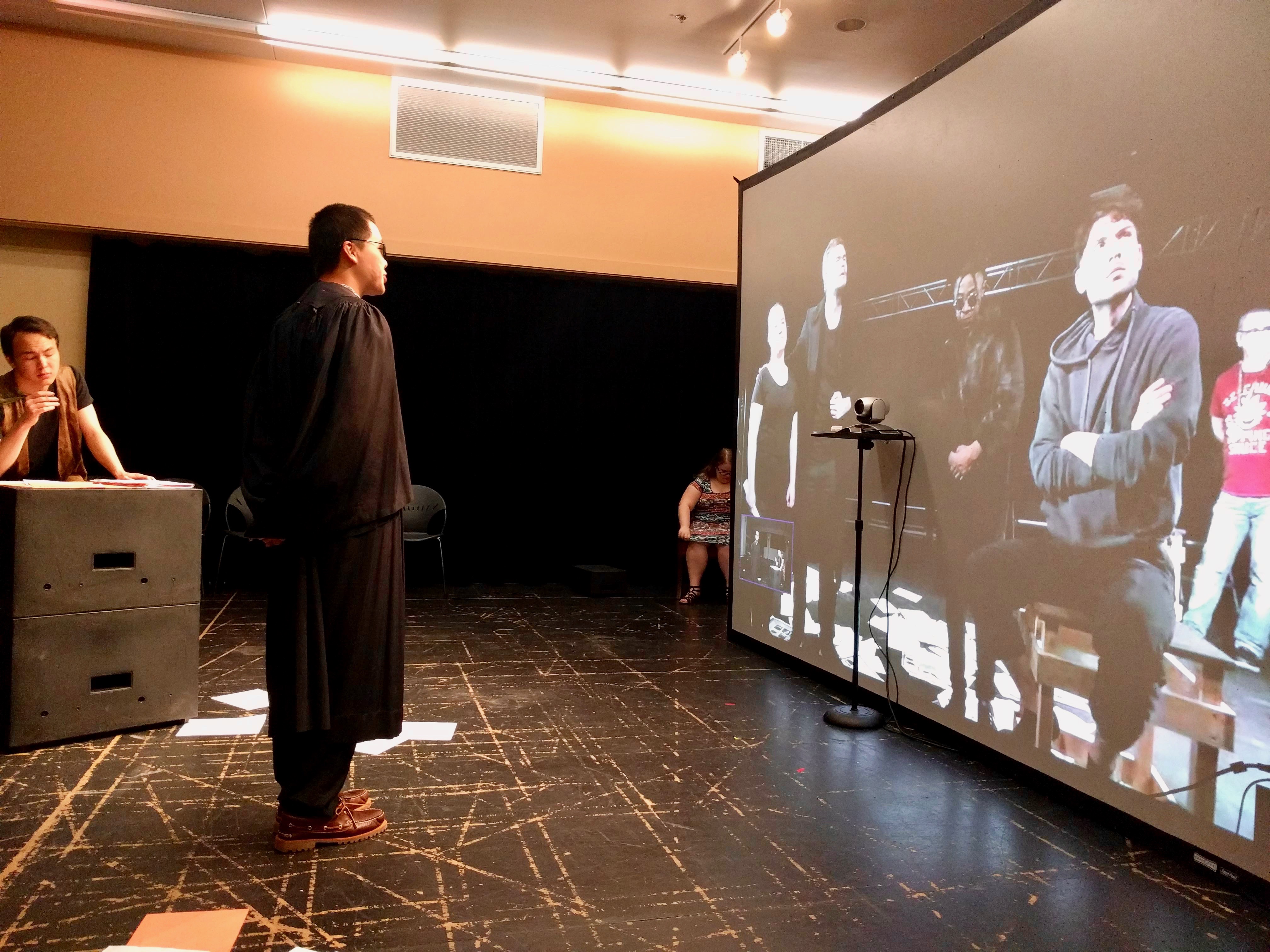
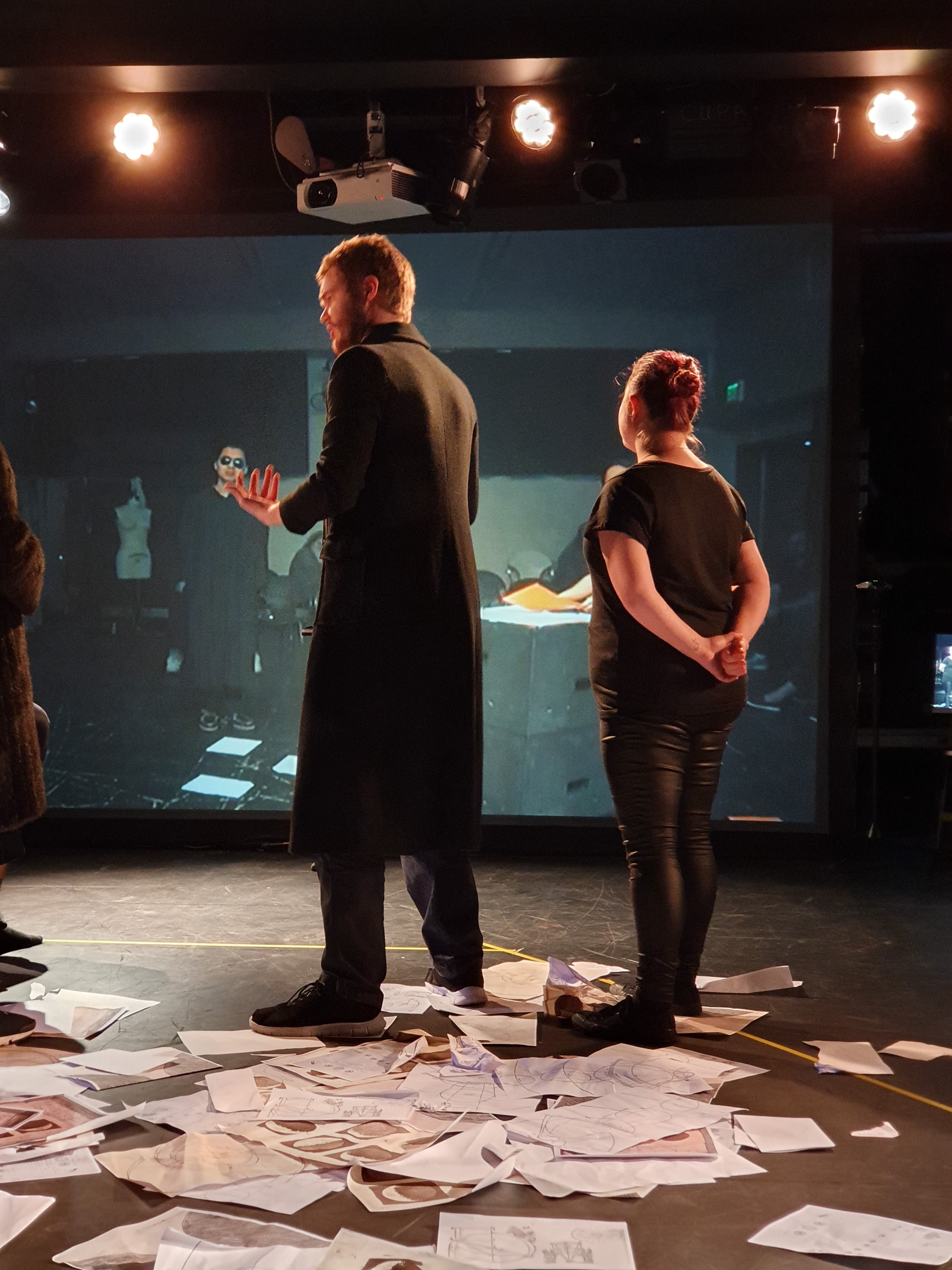
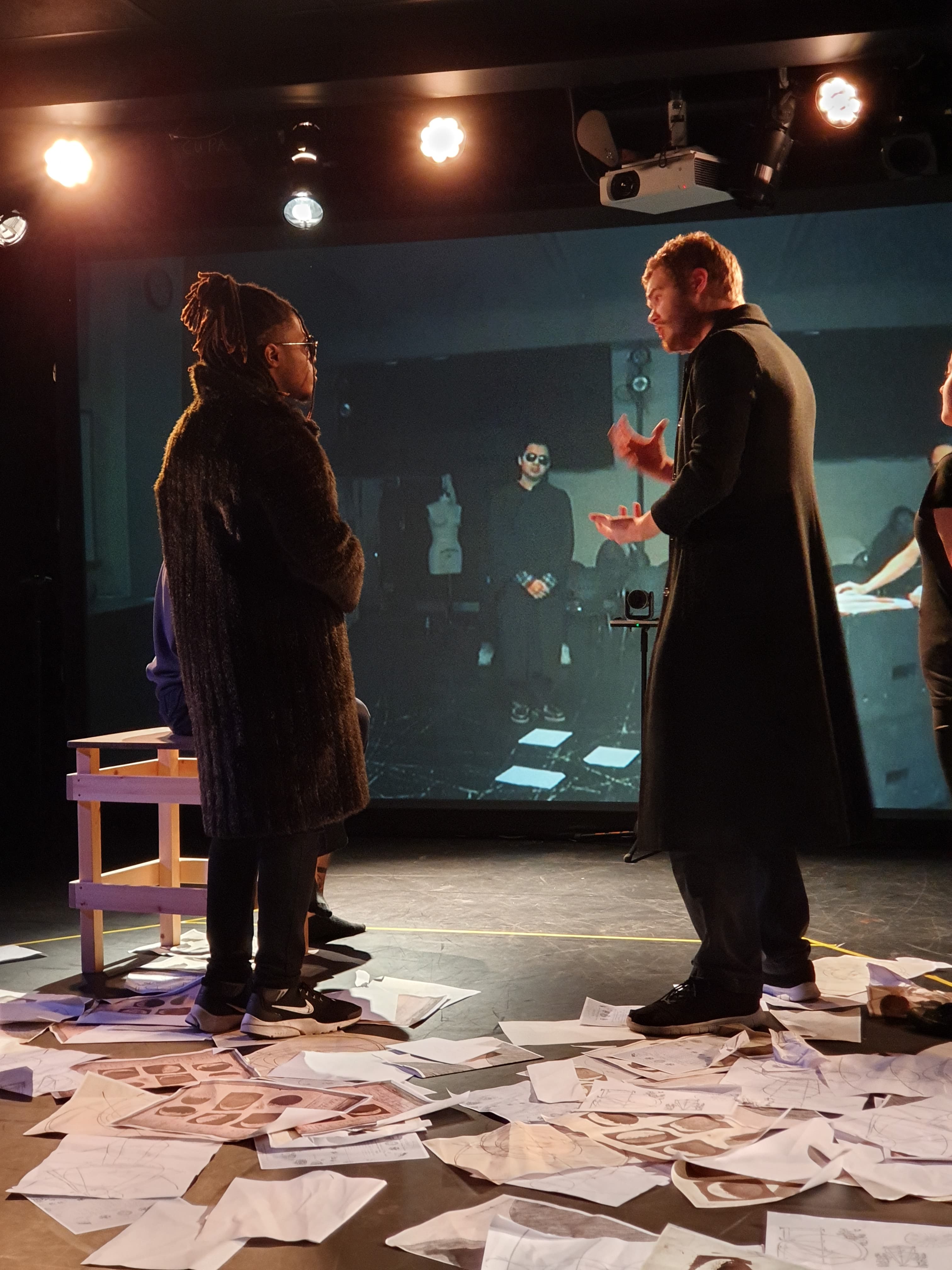
The project concluded with two performances for invited audiences in Coventry and Purdue. Each audience encountered performers who were physically present in its own studio alongside actors appearing live through the screen.
At Purdue, the technical arrangement limited the audience to approximately 30 people seated around the perimeter of the room. This enabled spectators to see both the projected image and the live performers while remaining within range of the telepresence microphone and sound system.
Audience surveys and discussions recorded by Fliotsos showed enthusiasm for the combination of live and digital performance. Questions initially concentrated on how the connection operated and how the actors managed its limitations. The discussions then moved towards the social and political implications of Brecht’s play, with performers from Britain and the United States comparing how its themes resonated within their own countries.

One performance also produced an unexpected personal connection. A member of the Coventry audience who had previously attended Purdue recognised Purdue participant and workshop leader Amy Lynn Budd as an old friend. After the performance, the two spoke through the telepresence system in an impromptu “virtual reunion”, a moment captured in the project documentary. For a few minutes, the equipment ceased to be a performance experiment and became a meeting place, reconnecting two people across the same screen that had brought the casts together.
The Purdue performer playing Galileo described the project as among the best experiences of his three years in graduate school, valuing the freedom to experiment with a form that belonged fully to neither stage nor screen.
Anne Fliotsos’s perspective
Fliotsos reflected on the collaboration in “A Time for Telepresence”, published in the SDC Journal in 2020. Written after the COVID-19 pandemic had interrupted study abroad and international theatre activity, the article considered Galileo Online as a possible model for cross-cultural collaboration when travel was unavailable.
Her account provides an external view of both the project’s potential and its limitations. She observed that students who were initially uncertain about the live and projected environment became immersed in the work after several days of shared warm-ups, theatre games and rehearsals. She also recognised that the system offered performers unusual control over framing, size and visual juxtaposition.
The article did not present telepresence as an effortless solution. It identified expense, space, technical support, sound quality, motion blur, latency and scheduling as continuing obstacles. Fliotsos concluded that a text as complex as The Life of Galileo needed more time for study and rehearsal, preferably over several months rather than two intensive weeks.
That criticism is important to the history of the project. Galileo Online demonstrated what could be achieved entirely at a distance, but it also showed the artistic compromises created by a compressed timetable and a transatlantic connection.
What Galileo changed
Galileo Online expanded the project in three significant ways. It moved beyond Shakespeare, created the first transatlantic student collaboration and tested a performance process in which the participants never met physically.
The project also showed the value of returning students. Because the Coventry cast had already worked through Caesar Online, they could carry practical knowledge from one collaboration into the next and begin exploring the telepresence camera as an artistic instrument. The system was no longer only a means of connecting two rehearsal rooms; it was becoming a performance medium with its own possibilities of scale, framing and juxtaposition.
At the same time, the collaboration exposed the limits of distance more clearly than the European projects had done. A five-hour time difference restricted the working day, latency affected rhythm, and two weeks allowed too little time for a play of Brecht’s complexity.
The students nevertheless created and presented work together without travelling between institutions. Their performances demonstrated that an international project could reach an audience while remaining entirely remote, provided that its participants were willing to build the difficulties of the medium into their creative process.