
(2015-16)
CORIOLANUS ONLINE: THE FIRST EXPERIMENT
Coriolanus Online began in January 2016 as the first practical test of what became Immersive Telepresence in Theatre and, eventually, Shakespeare Remote. Over two weeks, 20 acting students from Coventry University and 13 from Tampere University explored a single scene, Act 3, Scene 3 of Coriolanus, in Finnish and English.
This was not a complete production, and the students did not travel or perform together before an audience. Instead, the same scene was repeatedly rehearsed, tested and reconsidered across two connected studios. The immediate question was whether actors in different countries could do more than speak to one another through a screen. Could they work physically, develop relationships and create a genuine sense of ensemble while occupying separate rooms?
The documentary above follows that first experiment, including its technical problems, rehearsal discoveries and the students’ responses to working with international partners whom they never physically met.
ACTING IN A FOREIGN LANGUAGE
The project grew from Tampere’s long-established practice of Acting in a Foreign Tongue. Since the 1990s, acting students had worked on plays or scenes in languages unfamiliar to them, using the difficulty to sharpen physical expression, vocal attention and awareness of how meaning is communicated beyond vocabulary.
Shakespeare offered a productive meeting point. Finnish was unfamiliar to the Coventry students, while Shakespeare’s blank verse presented its own challenge to both groups, including the native English speakers. Working in both languages meant that neither side could rely entirely upon familiar habits.
Act 3, Scene 3 was chosen because it concentrates the conflict between Coriolanus and the citizens of Rome. After treating them with contempt and refusing to submit to political expectations, Coriolanus is banished from the city. In 2016, the four-hundredth anniversary of Shakespeare’s death, the scene also provided a way of considering the relationship between politicians and citizens at a time when political exchanges were increasingly taking place through digital media.
Before the practical work began, students attended contextual sessions on Shakespeare, Renaissance performance, Finnish theatre culture and Acting in a Foreign Tongue. These were delivered through Adobe Connect, a platform that pre-dated the widespread use of Zoom and allowed both cohorts to meet online before entering the larger rehearsal space.
BUILDING A SHARED REHEARSAL ROOM
The main challenge was that standard desktop videoconferencing reduced performers to faces within a frame. Theatre rehearsal depends upon bodies, spatial relationships, movement, timing and the ability to direct attention towards another actor. The team therefore needed to create the impression that the two groups occupied a continuous playing area.
An earlier source of inspiration was Extract/Insert, a 2012 mixed-reality installation at Coventry’s Herbert Art Gallery involving Joff Chafer, Ian Upton and performance artist Stelarc. The installation had connected physical activity with the virtual environment Second Life. It was not a theatre production, but it suggested how real and mediated spaces might be brought together at human scale.
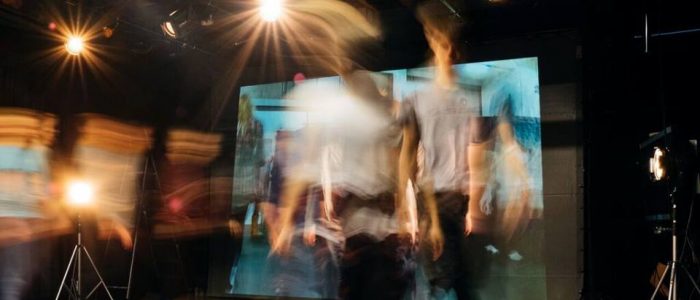
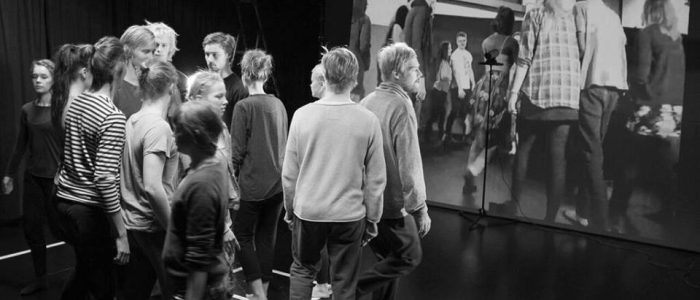
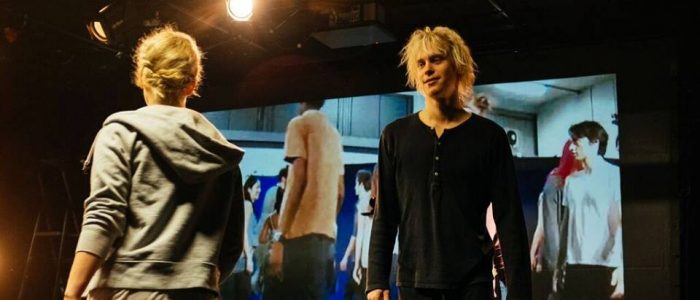
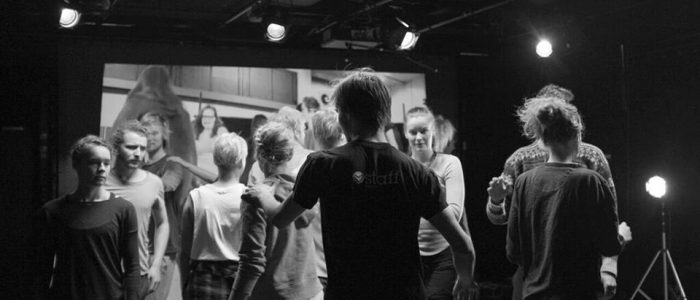
For Coriolanus Online, two matched rehearsal rooms were created in Coventry and Tampere using repurposed H.323 videoconferencing equipment, large rear-projection screens, directional microphones, aligned cameras and carefully controlled lighting.
Most of the technology was concealed behind the screens so that performers could concentrate on their partners rather than the equipment.
The Coventry studio occupied a disused university wind tunnel. Its height and depth made life-size rear projection possible, although its hard surfaces created severe echo and occasional feedback. The Tampere students worked in a black-box studio that was better suited acoustically to performance. Neither room had been designed for international actor training, so the apparent shared space was created from borrowed equipment, careful positioning and continual adjustment.
Camera placement was particularly important. Actors needed to appear to make eye contact across the divide, even though looking directly at the projected person did not always mean looking towards the camera. Sound and image delay also affected timing. The aim was never to pretend that the technology had disappeared completely, but to discover whether actors could work through its limitations without allowing those limitations to control the rehearsal.

Testing the Space
The first shared practical activity was a Finnish folk-dancing class led remotely from Tampere. Coventry students followed the movements through the life-size projection, establishing immediately that the connection could support physical teaching as well as spoken discussion.
Each morning included time for games, round singing and exercises proposed by the students. Some familiar activities transferred effectively, while others revealed the limits of the system. Latency made a game of Grandmother’s Footsteps almost impossible, and the Coventry wind tunnel sometimes returned voices as delayed, ghostly echoes. The students responded by changing rules, adjusting timing and finding new ways to complete actions across the screen.
 The 33 participants were divided into six smaller mixed groups, each with its own Adobe Connect room. These rooms supported detailed scene rehearsal, discussion and peer learning outside the main studio, with tutors moving between them to offer advice. They also allowed students to develop ideas independently before testing them at full scale.
Adobe Connect served a different purpose from the immersive room. It could not reproduce life-size bodies or a continuous playing space, but it allowed students to talk face to face, exchange interpretations and rehearse in smaller groups. It also became an informal social space. Students remained online after scheduled activity, talked about their lives and occasionally shared a “virtual beer”. A Facebook group provided another channel for rehearsal arrangements, research, technical guidance and conversation between sessions.
The main studio and the smaller online rooms therefore supported different kinds of connection. One allowed the actors to work physically across distance; the other gave them space to talk, plan and become acquainted without the formality of the larger rehearsal room.
What the first project revealed
As the two weeks progressed, the students became less preoccupied with the equipment and more willing to test what performance across the screen could achieve. They found ways to direct anger, attention and physical intention towards people who appeared present at life size but could not be touched. The screen remained visible, yet it no longer prevented the actors from feeling responsible to one another.
The bilingual element also revealed both a possibility and an unfinished ambition. Coriolanus Online included work in Finnish and English, but most of the shared process was still conducted in English. Later collaborations with Tampere were almost entirely English-language projects. Although Acting in a Foreign Tongue had inspired the original partnership, sustained bilingual rehearsal did not become central to the initiative until the collaboration with ESADIB in Mallorca began eight years later.
The first project nevertheless established the questions that guided everything that followed. It showed that remote rehearsal could remain physical, live and unpredictable, while requiring actors to become more conscious of voice, gaze, timing and space. It also demonstrated that an international ensemble could begin to form before its members occupied the same physical room.
What Coriolanus Online did not yet provide was a way to test those relationships in person. That next stage arrived with King Lear Online in 2017, when the Coventry students travelled to Tampere after the remote rehearsal period. The three-week structure that later defined the initiative began there, but its foundations had been laid inside the two imperfectly connected rooms of the first experiment.
Student reflections
Elina Saarela, a Tampere acting student, described how the apparent distance gradually became a form of connection:
“Somehow we made it feel that you could really be in connection with each other. Because of the feeling that you were in the same room, you really could feel, ‘I can really touch someone’, or find how to be in connection when you cannot touch someone physically.”
She also reflected on learning Shakespeare’s language from the Coventry students:
“It was great to learn the rules and learn how to break them as well. Something else that I gained was learning how people work and study in different countries and cultures.”
Oliver Kollberg began the project more cautiously:
“I was quite sceptical at first about having a course with half the group in England, but it turned out really well. I was surprised by how immersive it could be to act a scene with the screen as the connector.”
For Oliver, the most important result was not simply improved technology, but the group it enabled:
“Getting to know people from abroad was made quite easy, and it happened naturally. Having this feeling of a group was really great using just technology.”
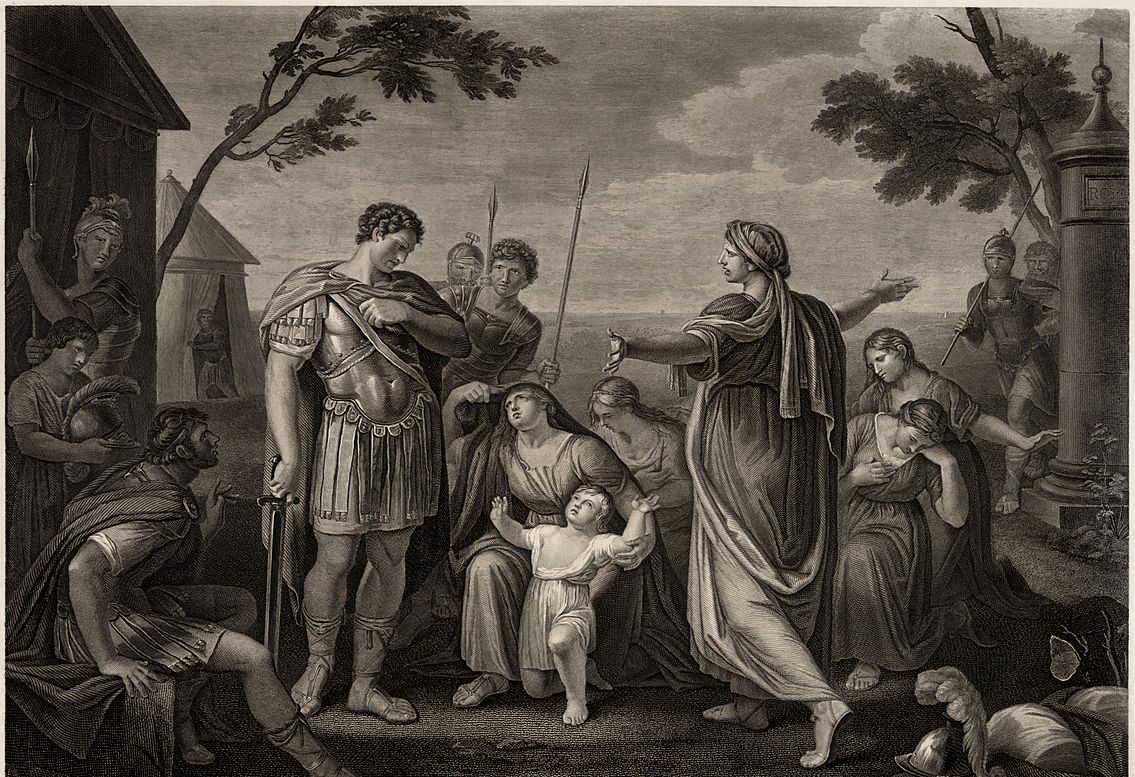
Top image: Coriolanus Act V, Scene III. Engraved by James Caldwell from a painting by Gavin Hamilton. Copyright holder: Adam Cuerden
Pictures by @naty_uta