

The Comedy of Errors Online (2026)
In March 2026, Shakespeare Remote marked its tenth anniversary with its most ambitious production to date. Twelve students from Coventry University and ten from L’Escola Superior d’Art Dramàtic de les Illes Balears (ESADIB) created a full-length bilingual production of Shakespeare’s The Comedy of Errors, rehearsed through telepresence and performed in Palma and Coventry.
It was the eleventh student project since the first experiment with Coriolanus in 2016. Every previous production had used selected scenes or a substantially shortened adaptation. Romeo and Juliet retained approximately 60 per cent of the play and As You Like It around 70 per cent. The Comedy of Errors was the first attempt to preserve the complete dramatic journey of a Shakespeare play, with only slight cuts for practical brevity.
This changed the scale of the undertaking. The company had to sustain an entire narrative, track a large number of characters and make the escalating confusion between two sets of twins clear across English and Catalan. Artistic decisions could no longer be confined to individual scenes because a small change in one part of the play could affect the logic of something much later.
The production was also the first exchange to operate fully in both directions. Coventry students travelled to Mallorca for the final rehearsal week and Palma performance, after which ESADIB students and staff travelled to Coventry to complete the project. Both institutions became hosts, and both groups experienced being the visiting company.
Three versions of one play
The greatest new challenge was creating the bilingual script. For the first time, the project worked with three complete documents: Shakespeare’s English text, a full Catalan translation and the hybrid performance script combining the two languages.
The Catalan translation was not a line-for-line equivalent of Shakespeare’s original. Like any serious literary translation, it made its own choices about vocabulary, rhythm, imagery and sentence structure. A response that followed naturally in the English version did not necessarily work when the preceding speech had been taken from the Catalan text.
This became particularly difficult when making small cuts. Every alteration had to be checked to ensure that the dramatic logic still worked in both languages. Google Translate became one practical checking tool, helping the Coventry team compare passages and identify possible discrepancies, but it was not treated as the final authority. Questions were checked with Catalan-speaking colleagues to make sure that a shortened speech still prompted a valid response and that important information had not accidentally disappeared.
The play’s frequent rhyming couplets added another complication. A rhyme, rhythm or verbal connection in Shakespeare’s English might be handled differently in Catalan, while changing language between two related lines could break the pattern completely. Constructing the hybrid text therefore involved more than allocating some speeches to each language. The team had to consider where a language change made theatrical sense, whether each exchange still sounded complete and what an audience could understand through context and performance.
The resulting script remained recognisably Shakespeare’s full play while allowing English and Catalan to share its structure. It was the most complicated adaptation the project had attempted.
Preparation on both sides
The project followed the model developed through the previous ESADIB collaborations:
- 2 to 13 March 2026: two weeks of online rehearsal and language work, with the casts connected between the Ellen Terry Building in Coventry and ESADIB in Palma.
- 14 to 20 March 2026: an intensive week of physical rehearsal in Mallorca, ending with an open-air performance in Palma.
- 24 March 2026: two performances in Coventry’s Hyperstudio, completing the reciprocal exchange.
Preparation in Mallorca began considerably earlier. Margarita Mulaku, who had performed in As You Like It Online, secured a Turing Scheme placement in Palma from January to March. Her presence at ESADIB gave the project something it had never previously possessed: an experienced Coventry participant working on the ground with the partner institution before the remote rehearsals began.
Margarita assisted with organisation, casting and English pronunciation before becoming a co-director and acting coach during the production. Having experienced the project as a performer, she understood the uncertainty students could feel when first entering the telepresence space. She could also anticipate the adjustments that would be required when work moved from the screen into physical performance.
Other former participants returned with new responsibilities. Finja Hoth had moved on from ESADIB to postgraduate study in Screen Acting in Cologne, but returned to assist with costume, props and fight choreography. Núria Garcia Martin, taking part for a third time, supported the direction and taught the company traditional Mallorcan singing and folk dancing. Diego Isern returned for a second year as a performer, alongside returning Mallorca performers Pau Oliver and Sofia Llompart.
Their presence meant that practical and artistic knowledge no longer disappeared at the end of each annual project. New students worked alongside people who understood the technology, the bilingual process and the transition from remote to physical rehearsal.
Ephesus and Palma
The choice of The Comedy of Errors was closely connected to place. Shakespeare sets the play in Ephesus, an important Mediterranean trading centre shaped by commerce, travel and the arrival of strangers. This offered a natural connection with Palma’s history as a Mediterranean port.
The production did not attempt to equate the two cities directly, but the parallel provided a visual and imaginative starting point. Ideas of movement, exchange, trade and the meeting of people from different places influenced the design, locating the comedy within a recognisably Mediterranean world.
The full play presented a much greater design challenge than the earlier Mallorca productions. Its numerous characters, rapid entrances, mistaken identities and repeated costume changes had to remain clear to audiences in both countries. Costume pieces needed to work for several performers while still helping the audience distinguish between characters, making colour, recurring visual details and practical construction essential.
On the Sunday of the Mallorca residency, members of the cast and creative team visited the Mercat de Vell de Consell to source local fabrics for the costumes and set. The visit became both a practical design expedition and another way of encountering the island beyond Palma. Materials found at the market brought something of Mallorca’s existing textures and material history into the production, instead of every visual element arriving with the visiting company or being purchased from a conventional supplier.
The production required considerably more props and mechanical scenic elements than either Romeo and Juliet or As You Like It. As before, the design developed alongside rehearsals through discussion, experimentation and the creative reuse of available materials. Objects, costumes and scenic details had to be made within a limited period and budget while remaining portable enough to serve performances in two countries.
Mallorcan culture was also present in the performance itself. Núria Garcia Martin taught the international company the Jota de sa Potada, a traditional Mallorcan song and dance, which opened the production with the entire ensemble performing in Mallorcan.
This was not simply introductory music added to establish a location. Learning it required Coventry and ESADIB students to work together on language, rhythm, movement and cultural context. It placed Mallorcan knowledge at the beginning of the production and gave returning participants responsibility for teaching the wider ensemble.
Rehearsing the complete play
Working on the complete play tested our model more severely than the earlier projects. Rehearsal groups had to coordinate character journeys, props, costume logic, scene transitions and recurring performance choices. The misunderstandings at the centre of the comedy needed precise timing, but the slight delay between Coventry and Palma made rapid exchanges more difficult. Students had to discover which rhythms could work remotely and which moments would need to be resolved when the company met.
The increased amount of bilingual text created a productive uncertainty. Performers could not rely solely upon the spoken words to understand what was happening. They had to read intention through tone, gesture, movement and their knowledge of the wider scene. Students supported one another with pronunciation recordings, translations and explanations, gradually taking responsibility for work that had initially been organised by staff.
Meeting in Mallorca
By the time the Coventry students arrived in Palma, they were joining collaborators with whom they had already rehearsed for two weeks. The physical residency began with an existing company, but direct contact changed the acting. Eye-lines, spatial relationships and movements created for the screen had to be reconsidered, while touch, shared breath and physical proximity became available for the first time.
Pau Oliver described the final week as the point when the project suddenly made sense. Voices that had previously sounded metallic became immediate and human, while physical contact and closer listening strengthened both the relationships and the performances. Costume helped the actors discover the characters and the broader, more playful tone of the comedy.
Cultural activity and informal time were again treated as part of the collaboration and had expanded to become central to the experience. By this third Mallorca production, close relationships with ESADIB had given the Coventry team a growing first-hand understanding of the island, its language and the pressures created by tourism. The residency continued to introduce visiting students to Mallorca through the people who lived and studied there.
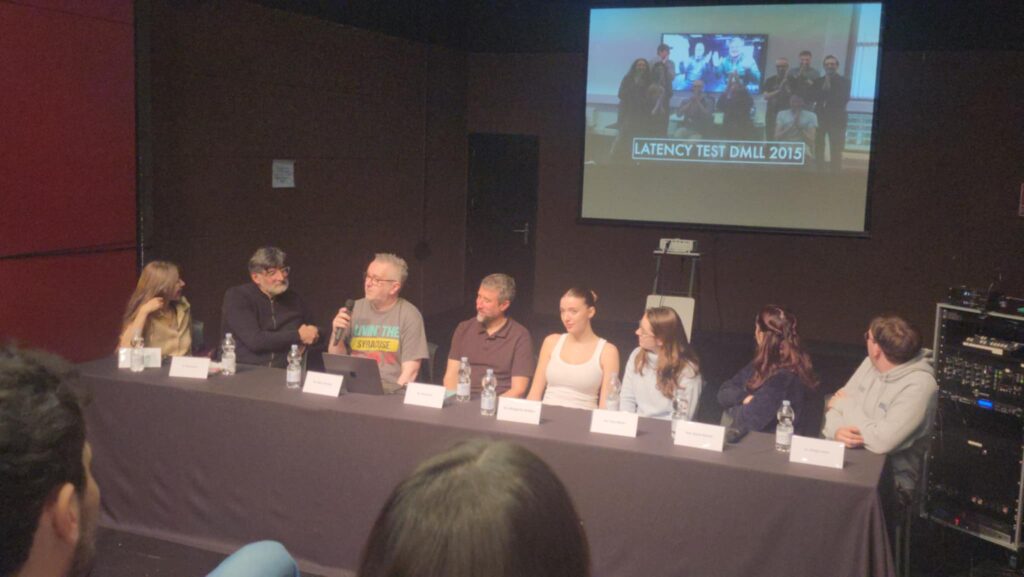
Pau Cirer also organised a symposium at ESADIB, presenting the project’s research and practice to both academic and general audiences. Staff, students and graduates discussed the use of telepresence in performer training, particularly its relationship with embodiment, presence, language and artistic risk. The symposium also launched the Mallorcan publication Shakespeare, telepresència i intermedialitat actoral, bringing together research, practitioner accounts and student reflections from the collaboration. This placed the production within a wider public conversation about what the project had learned and how its methods might develop.
The week ended with an open-air performance in Palma. Weather, surrounding noise and other factors beyond the company’s control required the actors to remain alert and adaptable. Other venues and dates had been explored on this occasion, including a performance on the Thursday in Alcudia but we decided to stick to our traditional Friday evening date and location as this additional performance would cause additional logistical problems that we could not iron out in the timeframe.
After the performance, a tenth-anniversary cake was presented to the company. It was a simple but affectionate acknowledgment of the distance travelled since the first Coriolanus Online experiment in 2016. Students, graduates and staff from both institutions were celebrating not only the completion of a production, but a partnership and community built through ten years of rehearsal across borders.
Completing the journey in Coventry
The final stage brought the ESADIB company to Coventry. Scenes that had moved from telepresence into an outdoor Mallorcan performance now had to be adapted again for the indoor Hyperstudio.
The Coventry performances changed the balance of the exchange. Mallorca was no longer the destination for a British student experience while ESADIB remained permanently at home. Mallorcan participants became visitors, Coventry students became hosts and local audiences encountered the bilingual production on the other side of the partnership.
This reciprocal journey fulfilled an ambition that had developed over the previous two years. Both groups experienced being linguistic guide and language learner, host and visitor, someone familiar with the location and someone dependent upon local knowledge.
A community students now help to organise
Margarita Mulaku, Finja Hoth, Núria Garcia Martin and Diego Isern have since become the founding members of the Graduate Organising Committee. The committee allows former participants to contribute to the planning of future projects, support incoming students and carry knowledge from one production into the next. It is intended to grow as other graduates become involved.
Pau Oliver and Sofia Llompart also demonstrate the continuity developing within the active student body. Returning as performers gave them the opportunity to apply their previous experience within a new cast and help first-time participants understand the demands of the process.
This progression is one of the most important outcomes of the tenth-anniversary production. Students have moved from participating in a staff-designed project to teaching languages and cultural practices, assisting with casting and organisation, directing scenes, planning fights, creating costumes and helping determine what happens next.
The Comedy of Errors Online therefore brought together more than ten years of technical and educational development. It combined the rehearsal structure established with Tampere, the bilingual practice created with ESADIB, a full-length hybrid script, a two-way exchange and a level of student leadership that had not previously been possible.
The production did not simply celebrate the project’s history. It demonstrated that Shakespeare Remote had developed a community capable of carrying that history forward.