
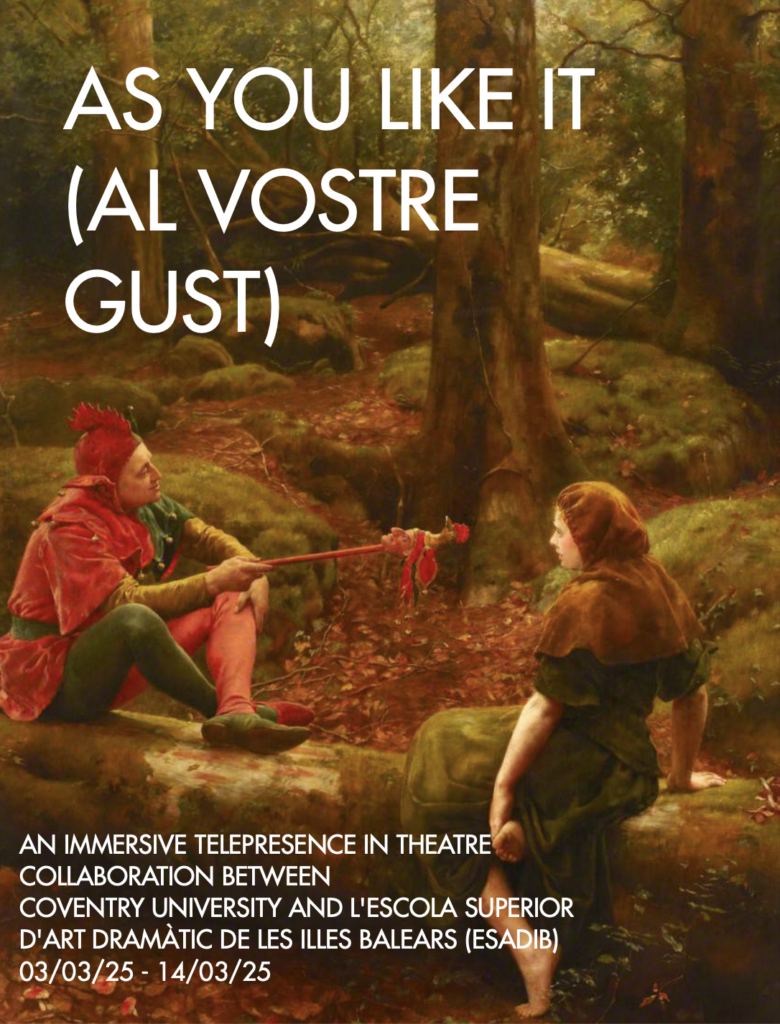
As You Like It Online (2025)
In March 2025, Coventry University and L’Escola Superior d’Art Dramàtic de les Illes Balears (ESADIB) continued their collaboration with an abridged bilingual production of Shakespeare’s As You Like It, or Al vostre gust. Approximately 40 per cent of the dialogue was performed in a Catalan translation by Miquel Desclot, with the remainder in Shakespeare’s English.
Students spent two weeks rehearsing through immersive telepresence before the Coventry group travelled to Mallorca for an intensive week of physical rehearsal, cultural activities and public performance at ESADIB.
Becoming Shakespeare Remote
The 2025 production also marked the formal adoption of the name Shakespeare Remote. The initiative had begun in 2016 as Immersive Telepresence in Theatre, a name reflecting its original focus on whether actors could rehearse together convincingly through connected digital spaces.
Shakespeare Remote had been used informally during Romeo and Juliet Online to describe the emerging Mallorca phase. By 2025, it was clear that the term better reflected the project’s developing focus on Shakespeare, bilingual performance and the relationship between remote rehearsal and international residency. The new title did not replace or conceal the project’s history. It identified a new phase built upon nearly a decade of work under its original name.
A new logo was designed to reflect this change, using two facing profiles and a connecting cable to suggest communication and the creation of a shared space. Its bold shapes and primary colours make a loose visual reference to Joan Miró, whose links to both Mallorca and Shakespeare gave the choice particular relevance. Miró lived and worked in Palma from 1956 until his death in 1983, and the Fundació Miró Mallorca in Cala Major preserves the studios and environment in which much of his later work was created. There is also a direct theatrical connection: in 1926 Miró worked with Max Ernst on the sets and costumes for Sergei Diaghilev’s Ballets Russes production of Romeo and Juliet, based on Shakespeare’s play. The Miró reference therefore connects the logo not only to Mallorca, but also, rather neatly, to Shakespeare and experimental approaches to theatrical design. The colour palette further brings together colours associated with the English and Mallorcan sides of the collaboration.

Learning from the previous company
Each production changes what follows. One of the clearest lessons from Romeo and Juliet Online was that three weeks provided little time to learn an unfamiliar language, understand the play and build an international ensemble simultaneously.
Planning for 2025 drew upon candid feedback from the previous company, particularly Núria Martín and Finja Hoth, with whom the team had remained in contact. The unedited student interviews recorded for the Romeo and Juliet Online documentary also offered a detailed account of what participants had found valuable, where they had felt underprepared and how the rehearsal period and residency might be improved.
As a result, the script and casting were distributed well in advance. Two informal Zoom meetings were held before the main course, allowing students to meet their scene partners and begin discussing the play. Breakout sessions in Catalan and Shakespearean English gave both groups time to practise pronunciation and resolve linguistic questions before rehearsals began.
Núria and Finja returned for a second year and helped establish a WhatsApp group for the new company. It soon developed beyond its original organisational purpose. Students exchanged pronunciation recordings, compared interpretations, arranged additional calls and shared music, images and jokes. By the time they entered the telepresence studios, they already knew one another’s names and had begun forming working relationships.
This was an important development. Communication was no longer managed entirely by staff or confined to timetabled sessions. The students had created an informal rehearsal room of their own.
Participants returning in new roles
The developing community also brought former participants back into the project in different capacities. Lily Beal, who had performed in Romeo and Juliet Online and was now studying at drama school, returned to work with the cast. Coventry student Aspen Hunt travelled to Mallorca as stage manager, working alongside designer Kieran Steward during the residency and performance.
Their involvement helped carry practical and artistic knowledge from one production to the next. Shakespeare Remote was beginning to retain experience between cohorts instead of rebuilding the entire process from the beginning each year.
Finding the Forest of Arden across distance
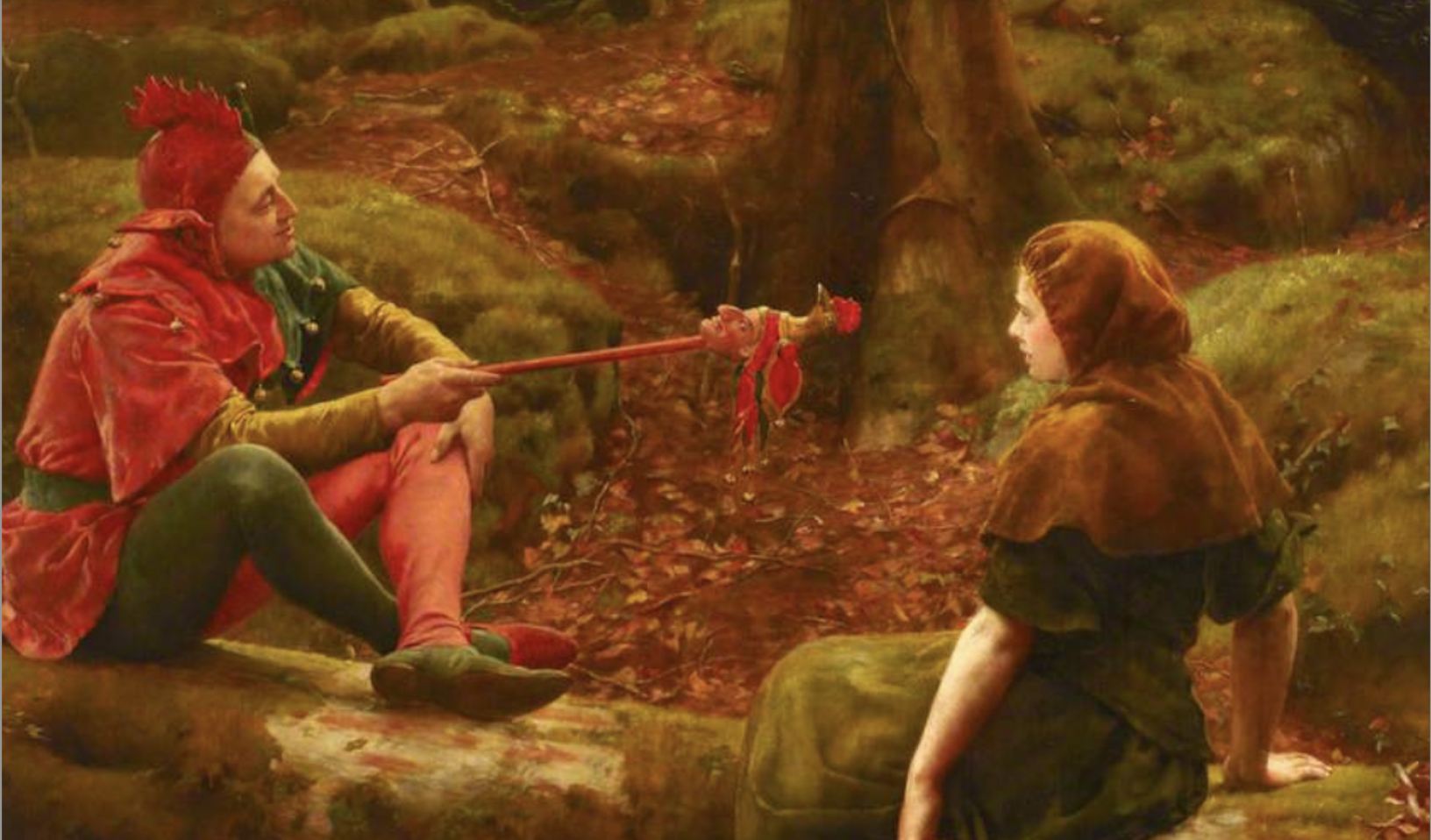
As You Like It presented different challenges from Romeo and Juliet. Its shifting identities, romantic misunderstandings and movement between court and forest required the performers to establish a shared sense of play while working in separate countries.
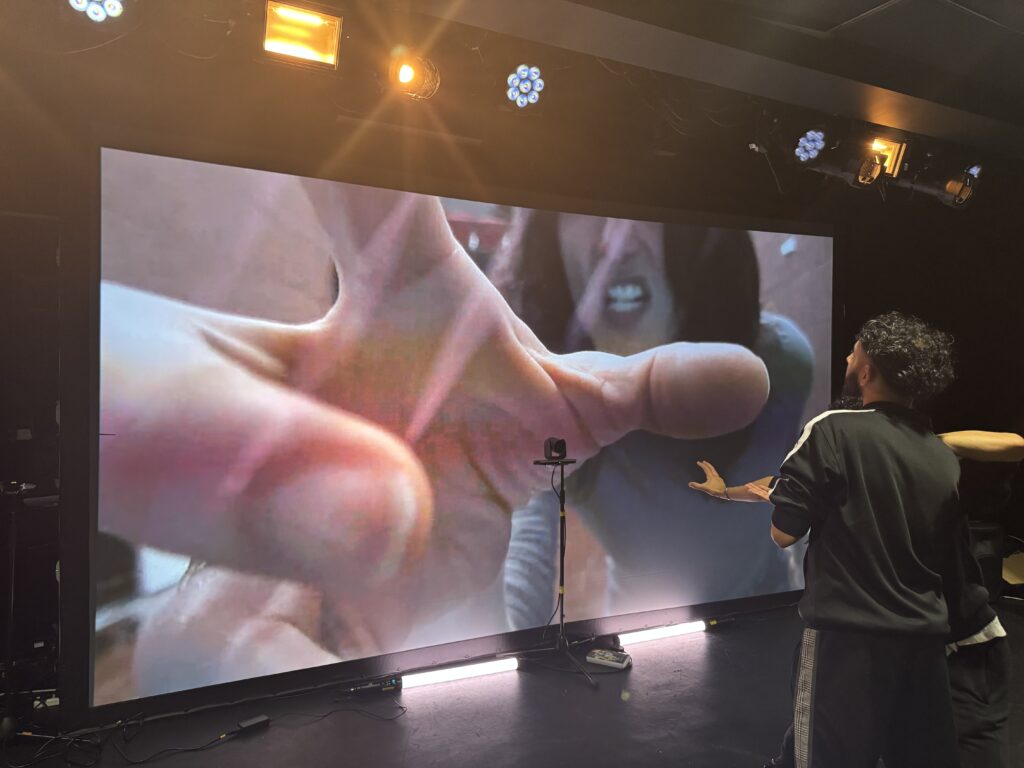
Daily warm-ups brought the whole company together before rehearsals moved into mixed scene groups. Working in English and Catalan required additional concentration, particularly during quick exchanges where meaning, rhythm and comic timing had to remain clear across both language and latency.
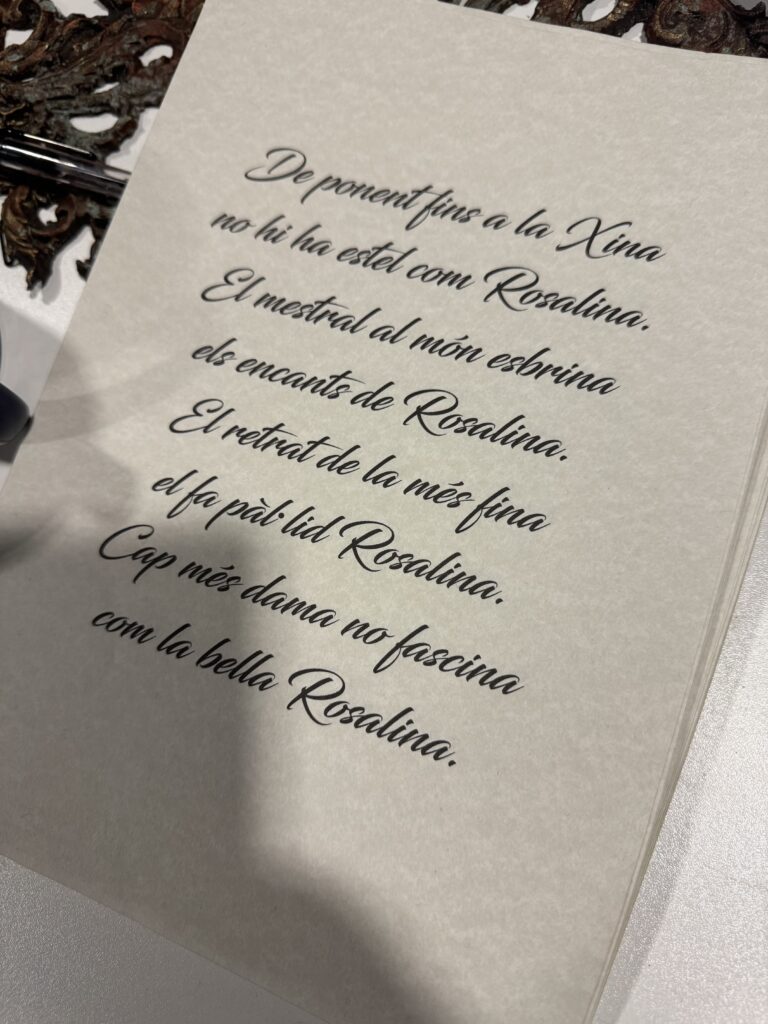
Music became an important part of the bilingual approach. The production used songs from the play, including “Blow, Blow, Thou Winter Wind” and “Under the Greenwood Tree”, drawing upon traditional English folk music while translating the lyrics into Catalan. This allowed Shakespeare’s pastoral world to be reinterpreted through the language of the host culture.
Music also exposed one of the limits of remote rehearsal. In one scene, a student in Mallorca needed to sing while a Coventry performer accompanied them on guitar. The transmission delay made live synchronization impossible. The pair arranged a separate Zoom meeting to find a strategy, rehearsed the other elements of the scene and accepted that the music would have to be brought together during the physical residency.
Fight choreography created a similar problem. Without direct physical contact, performers had to construct believable spatial relationships across the screen. These challenges helped define which parts of the production could be developed remotely and which needed to remain deliberately unfinished until the company shared a room.
As rehearsals continued, students took increasing ownership of the work. Scene partners arranged additional practice without prompting, supported one another’s pronunciation and developed performance choices outside scheduled sessions. By the end of the remote phase, the production was not complete, but its relationships, ideas and shared responsibilities were firmly established.
Meeting in Mallorca
The journey to Mallorca began with an appropriately theatrical accident. A road diversion on the way to Gatwick sent the Coventry group off course and into Warwickshire’s real Forest of Arden at two o’clock in the morning. Before entering Shakespeare’s imagined forest in Mallorca, they first had to find their way out of the original one.
When the students eventually arrived in Palma, their ESADIB partners were waiting at the airport with a handmade sign welcoming them to the Forest of Arden. Although the two groups had not previously met in person, the encounter felt more like a reunion than a first meeting.
The cultural programme was deliberately built into the residency. ESADIB hosts took the company to Sineu, where students prepared and shared traditional Mallorcan food, including pa amb oli, around a long table. Time spent at the beach, walking through local communities and sharing meals allowed the visitors to encounter Mallorca through the people who lived there.
These experiences were not tourism added around the edges of the course. The 2024 residency had made the project more aware of Mallorca’s distinct language and identity, as well as the pressures created by mass tourism. In 2025, the company returned in March, outside the peak visitor season, and cultural activities were organised through local partners instead of following a packaged tourist itinerary.
The project could not remove the impact of its own travel, but it could think carefully about how its participants arrived and what relationships they formed. Shared food, conversation and time outside rehearsal strengthened the trust upon which the bilingual performance depended.
Completing the production
The first physical rehearsals addressed work that telepresence could not complete. The song and guitar accompaniment initially appeared chaotic, while entrances, exits, fight sequences and spatial relationships had to be adapted to ESADIB’s courtyard. The company divided its time between the performance space and smaller rooms where scene partners could continue refining language and interpretation.
The week was intensive, but students used their remaining time to rehearse, explore Palma with their partners and continue the social relationships formed online. The distinction between the two institutional groups became progressively less important as they assumed responsibility for completing the production together.
Kieran Steward created a simple Forest of Arden using camouflage material, long lengths of linen suspended from the courtyard balconies and leaves scattered across the ground. The fabric responded to the Mallorcan air and architecture, while the relative simplicity of the setting kept attention on the actors, music and bilingual text.
The performance was not without stumbles, but the company supported one another and incorporated small mistakes into the live energy of the work. After the set had been hurriedly removed and ESADIB closed for the evening, the students gathered outside in Carrer del Morer. Still carrying the excitement of the performance, they began singing “Under the Greenwood Tree”, imperfectly, loudly and without staff arranging it.
It was an appropriate ending to a production that had become increasingly theirs.
An established partnership
As You Like It Online demonstrated that the collaboration could learn from one year to the next. Earlier preparation strengthened the bilingual work, returning participants carried experience between productions, and communication increasingly moved into spaces led by the students themselves.
The production also clarified how remote and physical rehearsal could perform different functions within one process. Telepresence allowed the company to establish scenes, relationships and shared responsibility over two sustained weeks. The residency added physical contact, place, cultural experience and the unpredictable energy of live performance.
What had begun with Romeo and Juliet as a new experiment was becoming an established international community. Formalising the name Shakespeare Remote acknowledged that development. Students were no longer simply taking part in a project designed for them. They were beginning to preserve its memory, create its social life and help determine what it would become.
DOCUMENTARY ABOUT THE PROJECT
FULL PERFORMANCE AT ESADIB