
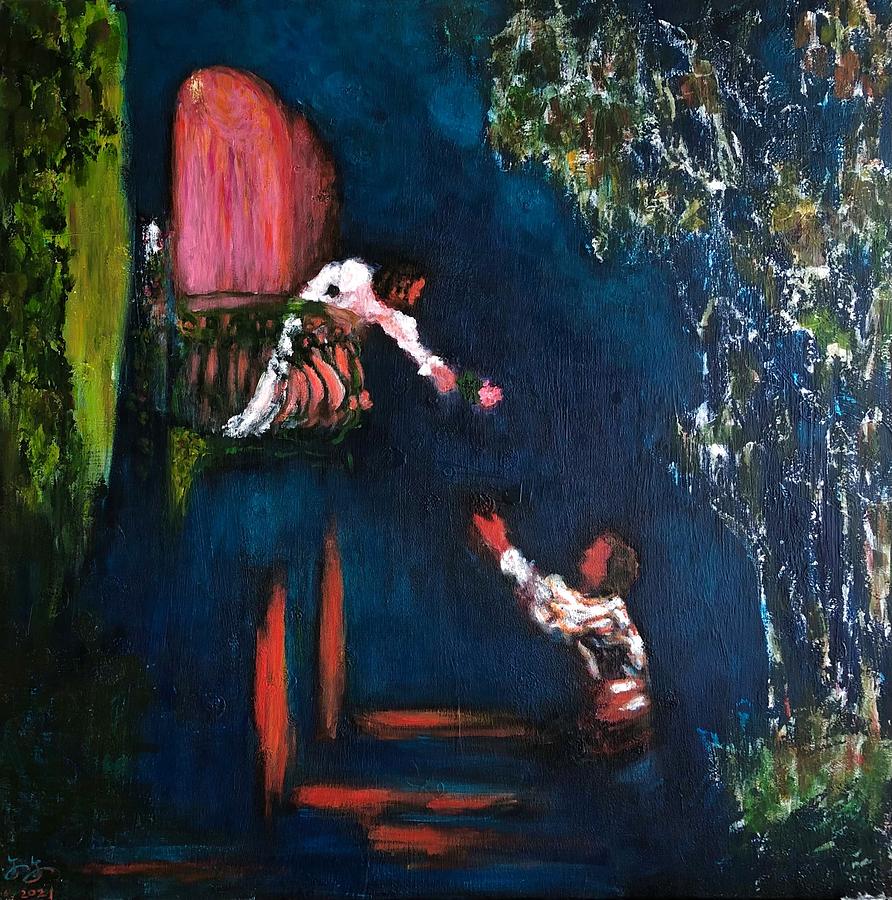
In March 2024, students from Coventry University and L’Escola Superior d’Art Dramàtic de les Illes Balears (ESADIB) collaborated on an abridged bilingual production of Shakespeare’s Romeo and Juliet. The project combined two weeks of rehearsal through immersive telepresence with a final week of physical rehearsal and public performance in Palma.
The partnership had developed gradually. In 2022, ESADIB professor Pau Cirer visited Coventry through an Erasmus exchange, sharing his work in mask and movement with staff and students. The following year Tom Gorman and designer Kieran Steward travelled to Mallorca, where they observed classes at ESADIB, delivered a presentation to staff and students about the project and began planning a collaboration with Pau Cirer, Biel Jordà, Fanny Marí and their colleagues.
This period of exchange allowed the two institutions to develop a shared understanding before attempting a production together. The intention was not simply to invite a new partner to use an existing system. Both teams would help decide what the collaboration should become.

Returning to an original intention
The partnership offered an opportunity to recover an idea that had inspired the first conversations with Tampere in 2015: actors might learn through working in an unfamiliar language. Coriolanus Online had included a small amount of Finnish, but the subsequent Finnish and international projects had been conducted almost entirely in English.
One of our first assumptions was that a production made in Mallorca would naturally combine English and Spanish. Our ESADIB colleagues challenged that assumption by explaining the importance of Catalan, and particularly its Mallorcan form, to the island’s cultural identity. Spanish might have been more familiar to the visiting group, but it would not reflect the language through which many of our partners understood their theatre, education and sense of place.
Mallorcan colleagues helped source high-quality Catalan blank verse translations by Miquel Desclot and Josep Maria de Sagarra. These gave the adaptation a strong theatrical foundation and allowed the Catalan sections to carry their own rhythm, imagery and dramatic weight. Catalan would not be included as a decorative gesture or a small concession to the location. It would become central to the production.
Romeo and Juliet Online was therefore the first iteration in which bilingualism shaped the whole creative process. Scenes were distributed so that every student had to work outside their first language. The choice of such a familiar play was deliberate. Because students already understood its central story, they could concentrate on how meaning, rhythm and emotion changed between languages.

For the Coventry students and staff, this meant learning Catalan pronunciation and discovering how unfamiliar sounds affected breath, movement and intention. ESADIB students encountered Shakespearean English, blank verse and iambic pentameter. Neither group possessed all the knowledge required to complete the work. Students had to listen carefully, take linguistic risks and depend upon their partners for pronunciation, meaning and cultural understanding.
This changed the balance of authority within the rehearsal room. English-speaking students could no longer assume that their familiarity with Shakespeare gave them control of the text. ESADIB students became the linguistic and cultural experts upon whom the production depended, while also accepting help when working with Shakespeare’s English.
Rehearsing across the screen
Each remote day began with shared ensemble training before the students moved into mixed scene groups. Exercises involving names, gestures, rhythm, imaginary objects and physical responses helped the actors understand how movement could travel between the two spaces.
An imaginary ball could be passed from Coventry into Mallorca, changing weight or texture as it crossed the screen. Other exercises explored synchronized actions, tableaux and the use of camera distance to alter an actor’s apparent size. Not every experiment succeeded. Group vocal exercises could overwhelm the microphones, while music played close to the equipment sometimes caused the sound to fluctuate. When this happened, the students adapted the exercise instead of abandoning it.
As the fortnight continued, the exchanges became less formal. Students joked across the screen, shared recordings of lines and arranged additional conversations through WhatsApp. The technology was beginning to support a social relationship as well as a scheduled rehearsal process.
The camera also became an artistic tool. Actors explored close-ups, shifts of scale and eye-lines that created the appearance of contact between performers in different countries. In the balcony scene, the contrast between a moving body in one studio and an enlarged, apparently distant figure on the opposite screen suggested a Juliet who seemed as unreachable as the moon. Ideas developed through the two-dimensional image later informed the physical staging in Palma.

Mask work introduced another way of communicating beyond language. Students explored how posture, rhythm and gesture could express character when the face was concealed, using the different mask collections held by the two institutions. Design work also developed through experimentation with costume, headpieces and found or repurposed materials.
Encountering Mallorca
After two weeks online, the Coventry students travelled to Palma. By this stage, the participants had rehearsed scenes, exchanged language guidance and begun forming personal relationships. ESADIB students met their Coventry partners at the airport, and the physical rehearsals began with an existing ensemble instead of two unfamiliar groups.
The transition still required adjustment. Eye-lines and movements created for the screen had to be reconsidered when bodies shared the same room, while scenes needed to acquire the breath, proximity and physical responsiveness that telepresence could only suggest. Much of the creative work nevertheless survived the change of medium.
The residency also began to overturn our assumptions about Mallorca itself. Like many British visitors, the group had previously understood the island largely through its international image as a Spanish holiday destination. Living and working alongside ESADIB students and staff revealed a place with its own language, history and cultural identity, as well as a complicated relationship with the millions of visitors it receives.
During the residency, we observed at first hand the growing public debate and protests surrounding mass tourism. Conversations with students and staff helped us understand some of the pressures placed upon housing, public space, natural resources and everyday life on the island. These discussions made it impossible to treat the location as an attractive background to a British student trip.
Shared meals, excursions and visits to cultural and creative spaces introduced the Coventry students to Mallorca through the people who lived there. They also prompted the project team to consider how future residencies could operate more responsibly. This included thinking about when projects should take place, how visiting students engage with local communities, which language is given prominence and how the exchange can benefit both institutions.
The project could not resolve the effects of tourism, and its participants remained temporary visitors. It could, however, acknowledge those conditions and allow them to shape how the collaboration developed. This became an increasingly important and deliberate part of the subsequent projects.
Performing in Palma
The production was presented publicly outdoors in ESADIB’s courtyard, a decision that became important to the way we approached the play. Romeo and Juliet was a work we had always resisted. The division between Montagues and Capulets could feel almost too obvious for the kind of exploratory work the project was interested in, while the play itself had been performed so frequently by schools and youth groups that it risked arriving with too much familiar baggage. Palma began to change our thinking. Its old town, with cobbled streets, arches, enclosed courtyards and, most importantly, its balconies, suggested something faintly Veronaesque. Performing in the courtyard allowed us to use that architecture rather than attempting to recreate Verona artificially.
One of the clearest signs that the setting was working came during rehearsals. When we worked on the balcony scene during the week, passers-by would often stop in the street to watch. Nobody needed to be told what we were rehearsing. The simple image of a young woman at a window and her lover appealing to her from the courtyard below was enough for people to recognise Romeo and Juliet almost immediately. It reminded us how deeply that particular image has entered the cultural imagination, and how little additional scenery was needed when the architecture was already doing much of the work.
At the same time, we did not want the setting to become a picturesque imitation of Renaissance Italy. One practical problem unexpectedly helped establish a much more contemporary approach. Romina, who was playing Romeo, had work commitments and often arrived partway through rehearsals in Palma. Parking in the old town is extremely limited, so we had to reserve a space for her close to ESADIB. Someone suggested that, rather than disguising her arrival, we should build it into the performance. Romeo would arrive by car.
That apparently simple idea required considerably more organisation than the audience would ever see. Romina waited with the car around the corner while we kept in contact by mobile phone so that she could be cued at precisely the right moment. We also had to make sure that the very narrow, effectively single-car Carrer del Morer leading towards ESADIB was clear. Romeo then drove into the playing space, parked beneath our improvised balcony, got out of the car and performed the scene. What appeared to be a spontaneous contemporary intervention was therefore the result of careful coordination and a practical difficulty being turned into a creative opportunity.
The moment helped define a broader principle for the production. Although Palma’s architecture had helped draw us towards Romeo and Juliet, we allowed the contemporary city to remain present rather than trying to conceal it. Helicopters passing overhead during the outdoor performance, for example, could suggest an atmosphere of surveillance around the young lovers rather than simply being treated as unwanted noise. Cars, aircraft, surrounding buildings and the ordinary sounds of Palma became part of the theatrical environment. The old-town setting provided echoes of Verona, but the production remained unmistakably contemporary and Mallorcan.
Performing outdoors also meant accommodating the open sky, surrounding architecture and sounds of the city, while the actors had to project the bilingual text clearly across the courtyard. The setting did not reproduce Verona literally. Instead, Palma’s balconies, courtyards and streets provided a visual framework into which contemporary life could enter.
The result retained the exploratory character of the project. It was an abridged production made in three weeks, not an attempt to conceal every difficulty behind a polished surface. What mattered was that the two groups had created a coherent piece of theatre through sustained negotiation across language, culture and distance. In many ways, the production’s relationship with its surroundings reflected the wider project itself: practical constraints were not necessarily obstacles to be hidden, but could become part of the creative process.

Language remained the greatest challenge. Students achieved more than might reasonably have been expected in the time available, but neither group had sufficient preparation to master every aspect of an unfamiliar language before rehearsals began. This became one of the project’s most useful lessons. Later productions introduced earlier casting, advance access to scripts, pronunciation recordings and informal meetings before the main rehearsal period.
A new phase
Romeo and Juliet Online restored confidence in the project after two difficult iterations and showed what the established telepresence model could become when language, place and cultural difference were built into its design.
It was also both a development and a return. The collaboration recovered the linguistic ambition that had inspired the original work with Finland, but carried it through an entire rehearsal and performance process for the first time. Bilingualism was no longer a small feature within an English-language project. It became the means through which students exchanged knowledge, negotiated authority and created the production together.
The experience also made the project more politically and socially aware. It was no longer enough to connect two rehearsal rooms or transport students to another country. The collaboration had to consider whose language was heard, whose knowledge carried authority and what responsibilities came with entering another community.
The name Shakespeare Remote emerged almost accidentally during this period. Immersive Telepresence in Theatre had always been the project’s formal title, but it was something of a mouthful and became even more cumbersome once the work expanded across languages. In Catalan it became telepresència immersiva en el teatre, while in Finnish it was Immersiivinen telepresenssi teatterissa. As the Mallorca collaboration developed, students and staff increasingly began referring to the project simply as “Shakespeare Remote”. There was no formal decision to rename it at first; the phrase was shorter, easier to translate, easier to remember and seemed to describe what we were actually doing. Gradually, it became the name everyone used.
By 2025, it was clear that the informal title had stuck and that it also captured the direction in which the project had evolved. It did not erase the history of Immersive Telepresence in Theatre, which remained its technical and educational foundation. Instead, it identified a new phase in which the central question was no longer simply whether actors could rehearse across distance, but what they might learn by depending upon one another across linguistic, cultural and national boundaries.
DOCUMENTARY ABOUT THE PROJECT
FINAL PERFORMANCE AT ESADIB, PALMA DE MALLORCA
Early rehearsal of ‘Queen Mab’ speech, Coventry Side
Rehearsal of ‘Queen Mab’ speech in the courtyard of ESADIB, Palma
Rehearsal of the Prologue at ESADIB, Palma
Gallery


CAST

ESADIB
Laia Pomar, Laura Bastida, Núria Martín, Finja Hoth, Cati Sureda, Aina Rodríguez, Aina Cárdeno, Romina Colotto
Coventry
Lily Beal, Chrystal Lomax, Lauren Parkins, Jona Lama, Obi Mbah, Linyun Yao, Stephanie Chen, Owen Teasdale, Meagan Mercer, Daisy Parr
Directed by:
Biel Jordà (ESADIB), Pau Cirer (ESADIB), Tom Gorman (COVENTRY)
Costumes:
Kieran Steward