
ESTABLISHING THE MODEL
King Lear Online began in February 2017 as the second iteration of Immersive Telepresence in Theatre. Students from Coventry University and Tampere University spent two weeks rehearsing selected scenes through connected studios before the Coventry group travelled to Finland for a one-week residency. In March, the two groups completed the work together and performed at Telakka Theatre in Tampere.
This was the first time remote rehearsal had been followed by the students meeting and performing in the same physical space. Coriolanus Online had tested whether actors could establish a connection across distance; King Lear Online asked what would happen when relationships, characters and artistic choices created remotely were carried into a live rehearsal room.
The project did not attempt to stage the complete play. Contrasting selections allowed the students to explore both larger public scenes and more intimate exchanges. Shakespeare remained a productive shared challenge because the Coventry students had begun developing experience of blank verse, while the Tampere students brought a different training tradition and perspective to the text.
The two-week remote phase and one-week residency established the structure that would later become central to Shakespeare Remote. The documentary on this page follows the process from the connected studios to the students’ first physical meeting and performance in Finland.
Documentary Overview of the Lear Online Project
Refining the shared rehearsal room
The first project had revealed what the rehearsal system could achieve, but it had also exposed its technical weaknesses. The Coventry studio had occupied a disused wind tunnel whose hard surfaces created severe echo and feedback. For King Lear Online, the work moved into an acoustically treated space where voices could be heard more clearly and performers no longer had to compete with the room.
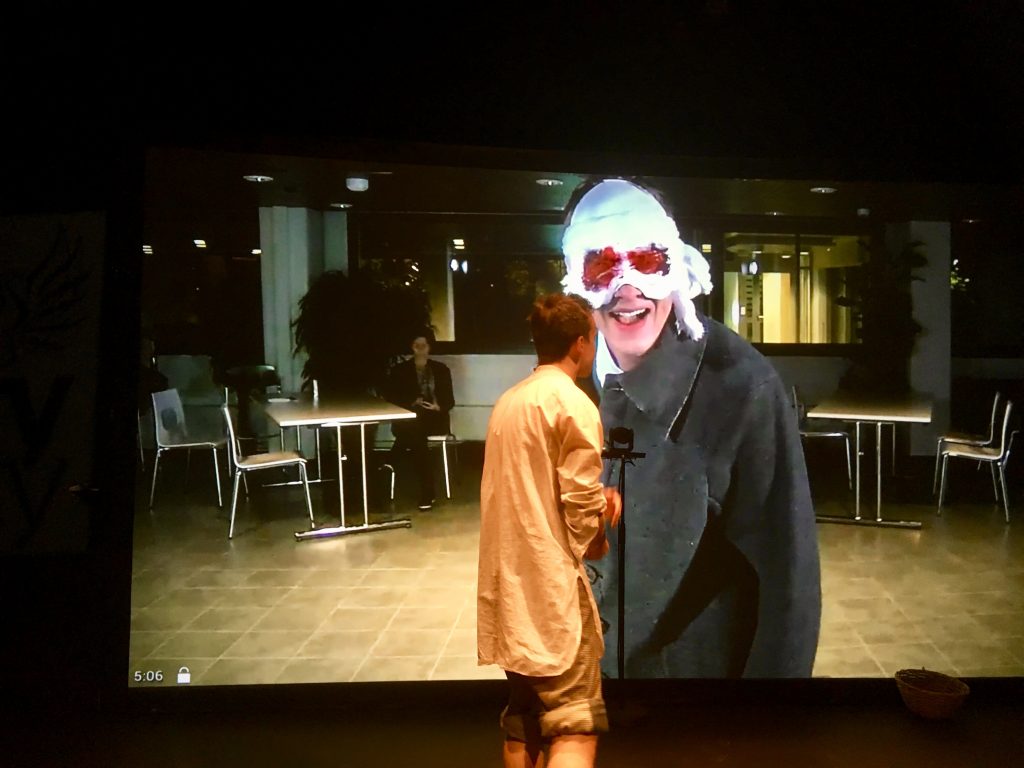
The visual system was also improved. Projection changed from the narrow 4:3 format used for Coriolanus to a wider 16:9 image, allowing more of each ensemble to appear at life size. Camera positions, lighting and eye-lines were refined so that actors could direct their attention more precisely towards particular partners on the other side. Improved research-network connections reduced the delay and made timing more reliable.
The equipment remained deliberately practical. Large-scale projection, directional sound and repurposed videoconferencing technology were arranged to create the sense of a continuous playing space without requiring a purpose-built commercial telepresence system. As the technical interruptions became less intrusive, the students could give more attention to acting, relationships and the play.
Elliot Sheppard, one of the Coventry students, remembered an early warm-up in which the illusion suddenly became convincing:
“When someone from the left-hand side of me was talking, you could see them all looking to their right. It looked like they were all looking exactly at the person on the other side. To know that they’re over a thousand miles away and we’ve got the technology to do this now is awesome.”
The final live performance at the Telakka Theatre, Tampere (March 17th, 2017)
Rehearsing for two Spaces
The students knew that they would eventually perform together at Telakka Theatre, but they had not yet entered that space. The remote rehearsals therefore concentrated on character, relationships, rhythm, intention and the movement of attention between performers. The cast avoided fixing detailed stage positions that might become unusable when transferred to Finland.
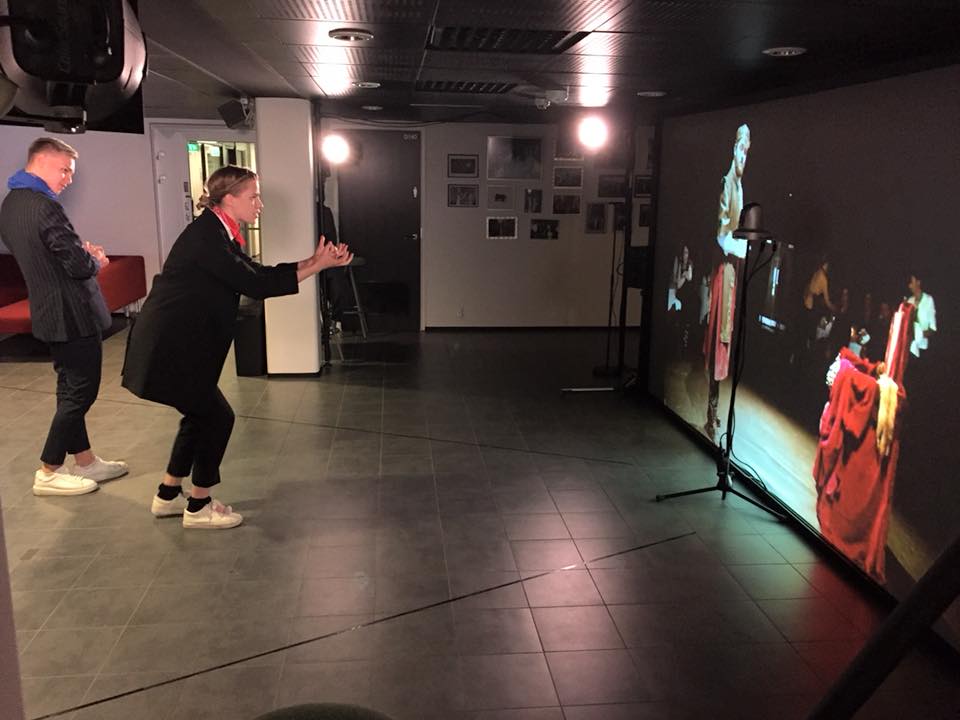
This did not make the remote period a preliminary discussion or an online read-through. Scenes were rehearsed physically, and artistic choices were tested through the life-size connection. The students worked with the particular qualities of the mediated space, including changes in scale, proximity and framing. Moving closer to the camera could produce an intimate close-up, while stepping away restored the fuller body and wider ensemble. These possibilities encouraged performers to move between techniques associated with stage and screen acting.
The telepresence space also supported ensemble training. Practical sessions included yoga, Asahi, group singing and choral exercises, alongside games and experiments suggested by the students. These activities tested whether breathing, rhythm and collective movement could be shared across the connection.
The technology still required adjustment. A small delay could complicate precise timing, while the camera did not always reproduce gaze in the way the actors expected. Instead of hiding these conditions, the students learned how to work with them. Their increased concentration in the remote studio later carried into the physical rehearsals in Tampere.
Accidental Breakout Spaces
As with Coriolanus Online, Adobe Connect supported the activity outside the main studios. Contextual lectures could be delivered to both cohorts, while smaller online rooms allowed groups to discuss the play, rehearse scenes and make decisions independently. A shared Facebook group was used for schedules, research, visual references and practical information.
These platforms also acquired a social purpose that had not been formally designed by the staff. Students remained online after rehearsals, talked about their interests and became familiar with one another’s personalities and working habits. This informal contact mattered because the students were preparing to perform with people they had never physically met.
For Coventry student Amy Middleton, one unexpected conversation captured the value of that space:
“We had a conversation with our Finnish counterpart and he just started playing the saxophone for us. We didn’t know he could play the sax until then. We’d been doing some script work and were talking about our lives and what we like to do, and he just started to play. It made the experience more personal for me.”
Amy recognised that this was part of the rehearsal process, not time outside it:
“With theatre, you need to have some connection, to get to know the people you’re acting with. You’ve got to get used to their mannerisms and their rhythms because you’ve got to do a performance together.”
The main telepresence studio allowed students to encounter one another as performers, while Adobe Connect gave them space to become acquainted as people. By the time they travelled, the groups had already developed a shared history.
Meeting in Tampere
When the Coventry students arrived in Finland in March 2017, the two cohorts were meeting physically for the first time, but they were not beginning the project again. They already knew the scenes, their partners and many of the choices that had emerged during the remote rehearsals.
The residency allowed them to test how those choices changed when projection was replaced by physical proximity. Breath, touch, peripheral vision and direct eye contact became available, while the staging could now respond to the architecture of Telakka Theatre. Work developed more quickly because the ensemble did not need to spend its first days establishing basic trust or introducing the text.
Steve Arnold, a Coventry student, identified the difference from the first project:
“I think the project had become a lot more refined since Coriolanus. We felt that we could just focus on the scenes. A huge difference was not just working through the screen but having an end goal. Performing live in Finland was something to build towards in the rehearsal sessions.”
The residency also extended beyond rehearsal. The Tampere hosts introduced the visiting students to the city and to aspects of Finnish cultural life, including sauna and ice swimming. These shared experiences developed relationships in ways that could not have been planned inside the studio and allowed the international group to spend time together without a rehearsal task directing every interaction.
The project culminated in a live presentation of selected scenes from King Lear at Telakka Theatre. The performance brought together work created across two forms of rehearsal, first through telepresence and then in a shared physical space.
What King Lear changed
King Lear Online established that remote rehearsal and physical residency could serve different but connected purposes. During the remote phase, the cast developed relationships, explored characters and made artistic choices before travelling. When the students met in Tampere, they were already an ensemble with a shared history, ready to discover how their work changed when projection gave way to touch, direct eye contact and physical proximity.
The project also showed that informal contact was as important as scheduled rehearsal. Conversations through Adobe Connect, shared cultural experiences and unplanned moments such as the saxophone performance helped create the trust upon which the final performance depended.
This became the central structure for later projects: students would first learn to work together across distance, then test and deepen that work in a shared physical space. King Lear Online demonstrated that telepresence did not need to replace physical meeting. Its value lay in changing what became possible when that meeting finally occurred.
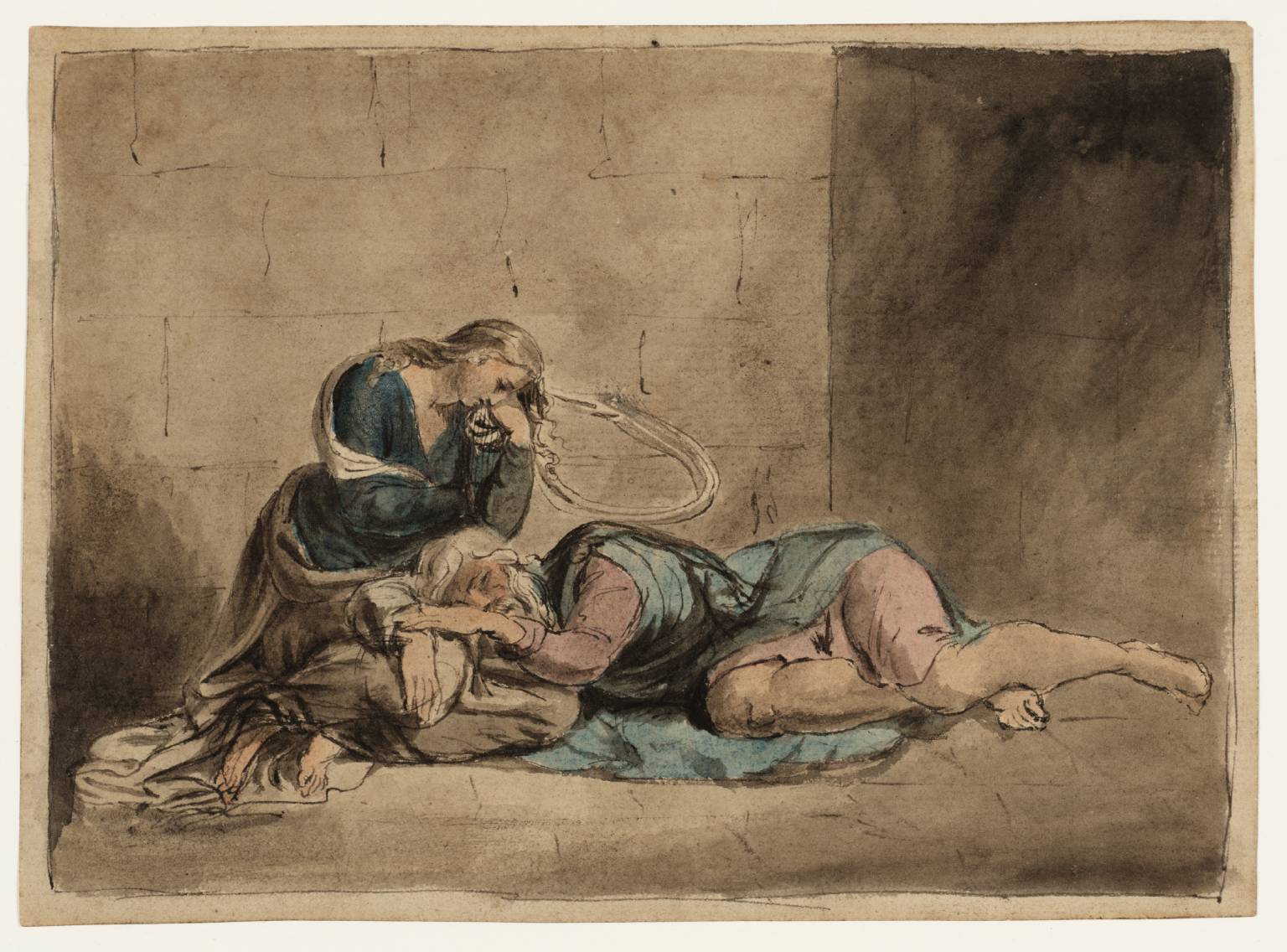
Top image: Lear and Cordelia in Prison circa 1779 William Blake 1757-1827 Bequeathed by Miss Alice G.E. Carthew 1940