
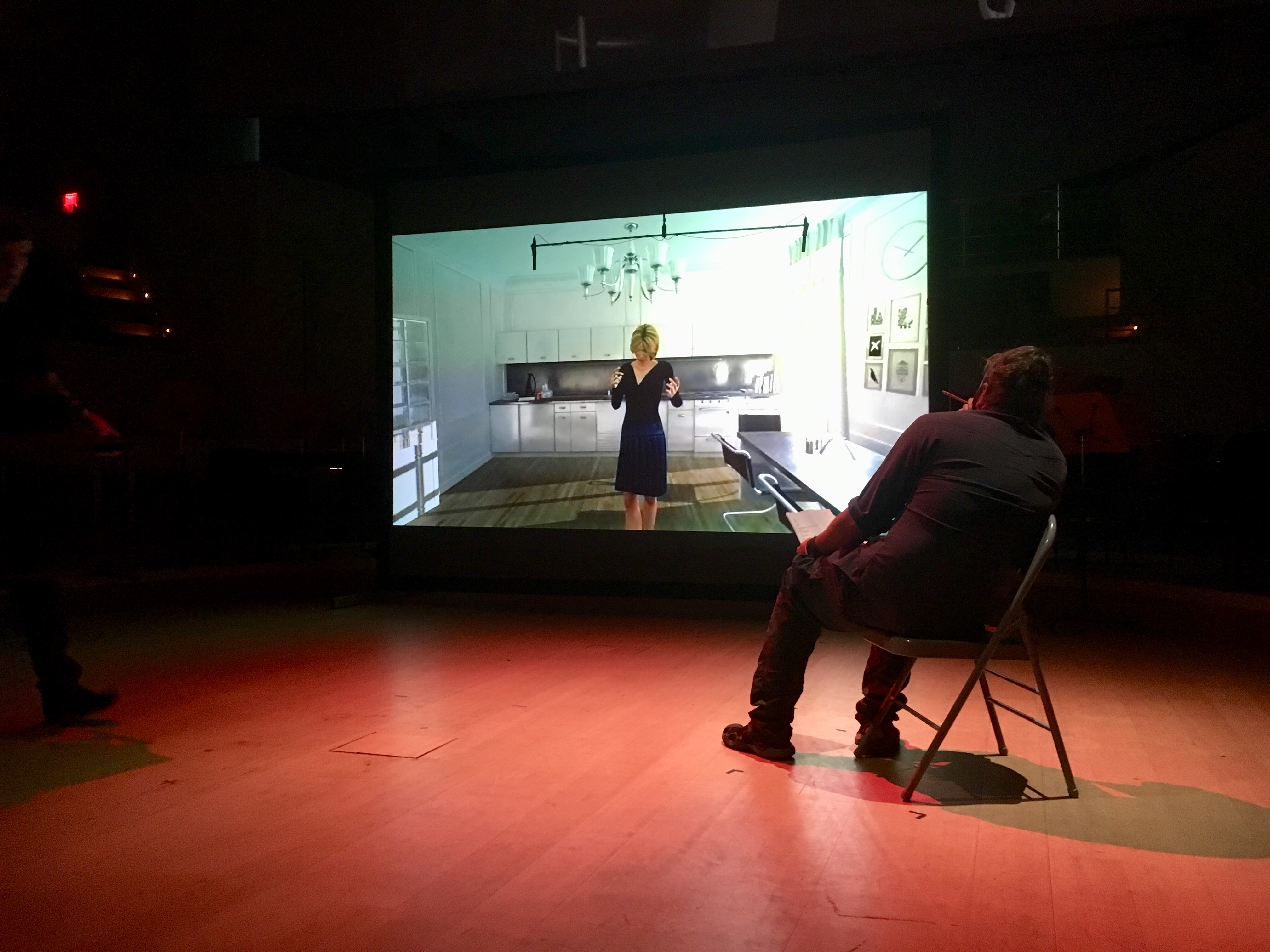
In April 2018, the project opened the annual Network Performing Arts Production Workshop at the New World Symphony in Miami Beach with a professional performance connecting Miami and Tampere.
The event was a technical and artistic offshoot of Immersive Telepresence in Theatre, not one of its student curriculum projects. It brought together a professional actor performing live in Miami, a motion-captured performer in Finland and a musician improvising from a separate Tampere studio.
The performance adapted an extract from Paris, Texas, Wim Wenders’s 1984 film, whose screenplay was written by Sam Shepard with L. M. Kit Carson. Its combination of separation, mediated communication and characters attempting to reach one another across emotional distance made it appropriate material for a performance divided across physical and digital spaces.
Joining the NPAPWS network
By this point, Tom Gorman had joined the organising committee of the Network Performing Arts Production Workshops, representing theatre within a network that brought together artists, educators, researchers and technical specialists working with advanced performance technologies. He continues to hold this role.
The annual workshop provided an opportunity to move beyond the repurposed videoconferencing systems used in the student projects and collaborate with specialists in professional media transport, motion capture and research networking.
The performance took place on 24 April 2018 and opened the NPAPW programme. Mikko Kanninen directed the work, Matias Palo led the Tampere production, and Tom Gorman provided creative supervision.
Three live streams, two countries
Professional actor Paul Tei performed physically before the audience in Miami. In Tampere, actor Katariina Havukainen worked inside a motion-capture studio, with her movements transmitted as a live digital avatar. Mikko Hautakangas accompanied the scene with improvised music, also performed live from Finland.
Three streams therefore operated simultaneously. One carried the live actor between Miami and Tampere, another transmitted the motion-captured avatar, and a third brought the musician into the performance. The streams were composed within the Miami presentation so that the live actor, digital performer and musician appeared to participate in the same event.
The music was displayed through a separate feed positioned above the dramatic action. This made the musician visible as part of the performance while preserving the distinction between his contribution and the encounter between the two actors.
Unlike the student rehearsal rooms, which projected remote performers at life size within a matched physical environment, Paris, Texas created a genuinely virtual stage. The motion-captured actor did not simply appear as a video image from Tampere. Her physical actions controlled an avatar placed within a digitally created setting, while Paul Tei remained visibly present before the Miami audience.
Working with Nimbra
The three streams were carried through the Nimbra media server developed by Net Insight, supported by advanced research-network infrastructure. Nimbra was designed for professional broadcast and live-media transport rather than university videoconferencing, offering greater stability, higher-quality transmission and the ability to manage several simultaneous feeds.
These capabilities made the performance possible, but they came with considerable complexity. Configuring the Nimbra system in Miami took a substantial amount of time and required specialist technical knowledge. Each stream had to be established, tested and synchronised before the performers could work together reliably.
The experience revealed a recurring tension within the project. More advanced technology could improve image quality, reduce delay and expand the range of possible staging, but it also required more expertise, preparation and expense. The apparent simplicity of the final performance concealed a lengthy technical process.
Nimbra therefore did not immediately replace the Polycom systems used for the student collaborations. Polycom offered fewer artistic possibilities but was easier to install, explain and operate with new institutional partners. The Miami event explored what could be achieved at the upper end of the available technology, while the curriculum projects continued to prioritise equipment that could be adopted with more modest resources.
Opening NPAPW 2018
The final performance placed Paul Tei before the audience in the New World Symphony’s performance space while the two Tampere contributions reached him through the network. The live and digital elements were not presented as separate demonstrations. They formed one continuous scene in which the performers had to respond to one another in real time.
Opening NPAPW with a theatrical performance also made a case for including actors and directors within a field often led by music, networking and broadcast specialists. Theatre introduced different demands: spoken dialogue, embodied character, visual composition and the need to maintain dramatic relationships across a mediated space.
The demonstration showed how motion capture, telepresence and live music could be combined without reducing the performers to prerecorded content. Every element remained live, and the event depended upon the actors, musician, technicians and network responding together.
What the Miami performance demonstrated
Paris, Texas extended the project beyond the matched rehearsal rooms developed for Coventry and Tampere. It brought together professional performance, motion capture, improvised music and broadcast-grade networking within a single international event.
It also provided an important lesson about technological ambition. The Nimbra system enabled three live streams and a more complex visual environment, but its lengthy set-up showed why the most advanced equipment was not always the most appropriate choice for teaching. A system intended for regular international actor training also needed to be affordable, understandable and practical for new partners to adopt.
The Miami performance remains separate from the eleven student projects in the Shakespeare Remote history. Its significance lies elsewhere: it demonstrated what the project’s ideas could become when professional performers and specialist networking technology were brought together at an international gathering.
Film courtesy Justin Trieger, New World Symphony.
Cast:
Travis: Paul Tei
Jane: Katarlina Havukainen
Guitar and Effects: Mikko Hautakangas
Directed by Mikko Kanninen
Production by Matias Palo
Creative Supervision by Tom Gorman
Performance of Paris, Texas with behind the scenes footage